
Rethinking How Leaders Coach in Everyday Work
I teach coaching courses in MBA and DBA programs Across four separate classes, I asked approximately 120 internationally certified coaches, all of whom also held managerial roles in their organizations, to conduct a coaching conversation using a widely established model within a compressed timeframe. This served as a baseline assessment.
Not one completed the conversation in under 30 minutes.
These were not managers encountering coaching for the first time. They were certified practitioners with coaching knowledge and organizational responsibilities. Yet even for this group, completing a conventional coaching process required considerably more time than a typical workplace interaction allows.
This observation raises an important question: if experienced, certified coaches struggle to deliver a conventional coaching process within a short window, what should realistically be expected of managers who are being asked to use the same approach in the middle of their working day?
Why Existing Frameworks Fall Short for Coaching in the Flow of Work
Established coaching models such as GROW and the Coaching Wheel have given the profession valuable structure. They help people examine situations carefully and move toward clearer decisions. Their contribution is real.
The difficulty appears when those same tools are asked to perform in a different setting. Leadership is full of short, task-linked exchanges. A team member raises a concern between meetings. Hesitation surfaces during a routine check-in. A decision needs clarification before the next handoff. These moments are not booked sessions. They sit inside the ordinary rhythm of work. The leader still carries accountability for results and may need to exercise authority in the same exchange.
Expecting leaders to transfer a method built for a dedicated engagement into these conditions creates a practical mismatch. The issue is not simply whether leaders know how to coach. It is whether the method itself supports effective coaching in the flow of work.
Time as a Structural Constraint on Coaching in the Flow of Work
A leader responsible for fourteen people who allocates even fifteen minutes of individual coaching to each person is already committing three and a half hours per coaching cycle. That figure excludes preparation, follow-up, and the rest of the operational load. A process that depends on protected coaching time cannot be applied every time a short opportunity appears.
One common reaction is to compress an existing process and label it “fast coaching.” The stages remain the same; only the clock is tightened. The result is usually a hurried sequence in which reflection is cut short and the pressure to finish takes over. That approach is not a smaller design. It is a full process forced into a narrower window. Speed does not solve a mismatch between method and context.
What is required for genuine coaching in the flow of work is a different unit of interaction—one built from the outset for brief, work-connected exchanges rather than a shortened version of a longer engagement.
Evidence of Barriers to Coaching in the Flow of Work
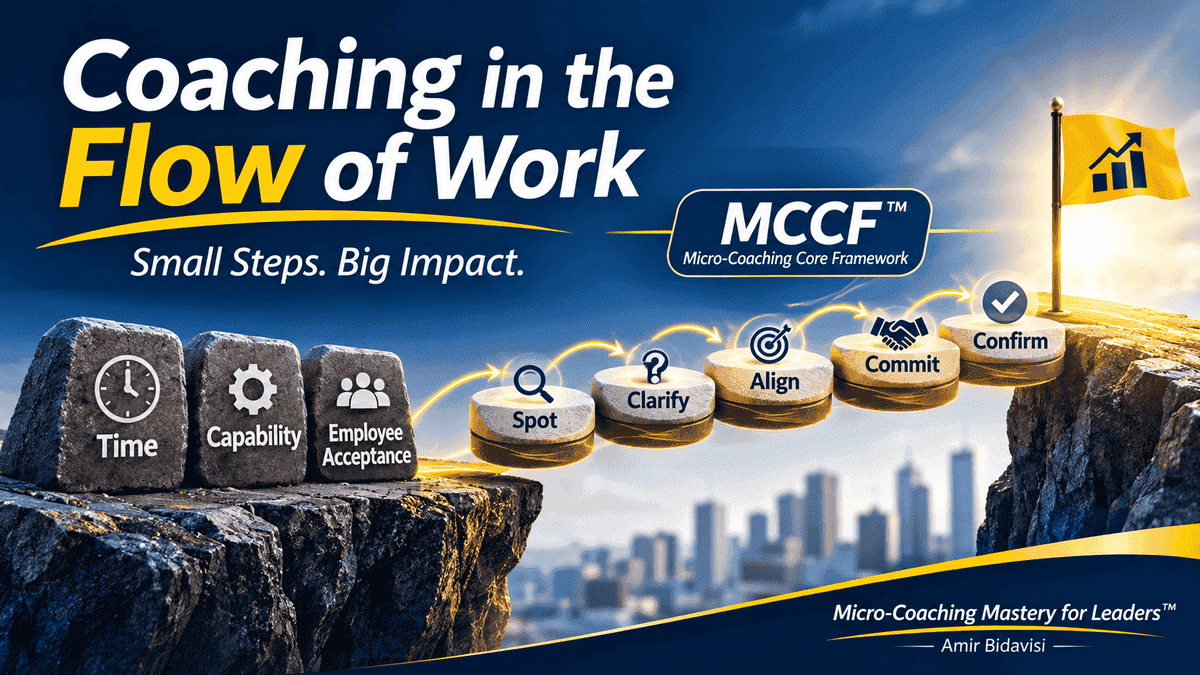
Research points to three connected barriers: time, capability, and employee willingness.
1. Time Constraints
Time remains a practical obstacle to managerial coaching. Carvalho and co-authors (2023) identify time among the barriers managers face when attempting to implement coaching. The problem is not simply a full calendar. It is the difficulty of fitting a process designed for dedicated conversations into the continuous demands of operational work.
2. Capability Constraints
The ability to coach effectively is another challenge. Carvalho and co-authors (2023) identify ability as a practical obstacle to managerial coaching. In addition, repeated observation in professional education settings reveals that certified coaches trained in conventional models frequently struggle to complete a standard conversation inside a short window. Knowledge of the method does not automatically translate into fluent use under operational time pressure.
3. Employee Willingness
The employee’s willingness to engage in coaching is also important. Pramana (2026) examined coaching inside hierarchical organizations and found that role confusion, cultural caution, and perceived career risk gradually weakened the intended process. Carter and colleagues (2017), drawing on responses from nearly three hundred professionals across multiple countries, found that difficulties linked to the coach, the relationship, and the overall experience predicted limited results more strongly than the absence of organizational backing. Kruger and Terblanche (2025) analyzed unsuccessful cases and highlighted mismatched expectations and strained relationship dynamics.
Together, these findings show that effective coaching in the flow of work depends on more than managerial knowledge or training. It requires a design that accounts for time, managerial capability, and the employee’s willingness to engage.
Diagnosing the Gaps That Prevent Coaching in the Flow of Work
The barriers cluster around three connected gaps: time, capability, and employee willingness. They also point to one prior decision that leaders must make before choosing how to respond.
The Time Gap
The time gap appears because many frameworks assume a protected slot. Even a brief scheduled conversation still requires a transition out of the current task and back into it. That transition is often unavailable when the need for coaching in the flow of work arises.
The Capability Gap
The capability gap appears when leaders know the techniques yet lack a clear sequence for using them in a short exchange. Knowing what questions to ask does not automatically tell a leader how far to explore, when to move toward options, or how to close.
It also involves knowing when coaching is appropriate and when the situation requires managerial intervention. A manager remains accountable for outcomes and may need to make decisions. Applying principles drawn from non-directive coaching traditions without adjustment to a hierarchical relationship can make questions feel artificial or evasive (Passmore & Fillery-Travis, 2011).
The Employee willingness Gap
The employee willingness gap appears when the employee is not ready or willing to engage in the conversation. Role confusion, cultural caution, perceived career risk, mismatched expectations, and strained relationship dynamics can all make coaching difficult to accept. Establishing a shared understanding is therefore essential. Both parties need a common understanding of the goal, the boundaries of the conversation, and the task context. Without it, even well-intentioned questions can pull in different directions.
One Prior Decision: Coach Thinking, Manage Authority
Not every workplace problem is a coaching opportunity. Sometimes a team member has the authority and capability to act but lacks clarity. Coaching helps. When the obstacle is a missing resource or a decision that exceeds their authority, further questions will not remove it. The leader must decide, resolve the dependency, or provide the resource.
The distinction is fundamental: coach thinking, manage authority.
A Framework Built for Coaching in the Flow of Work
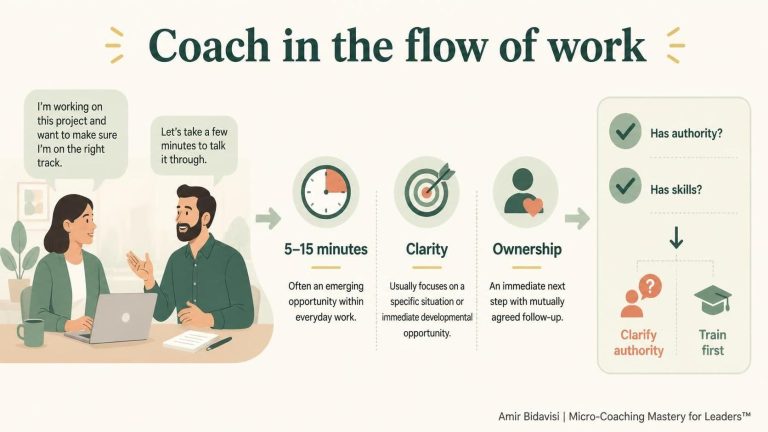
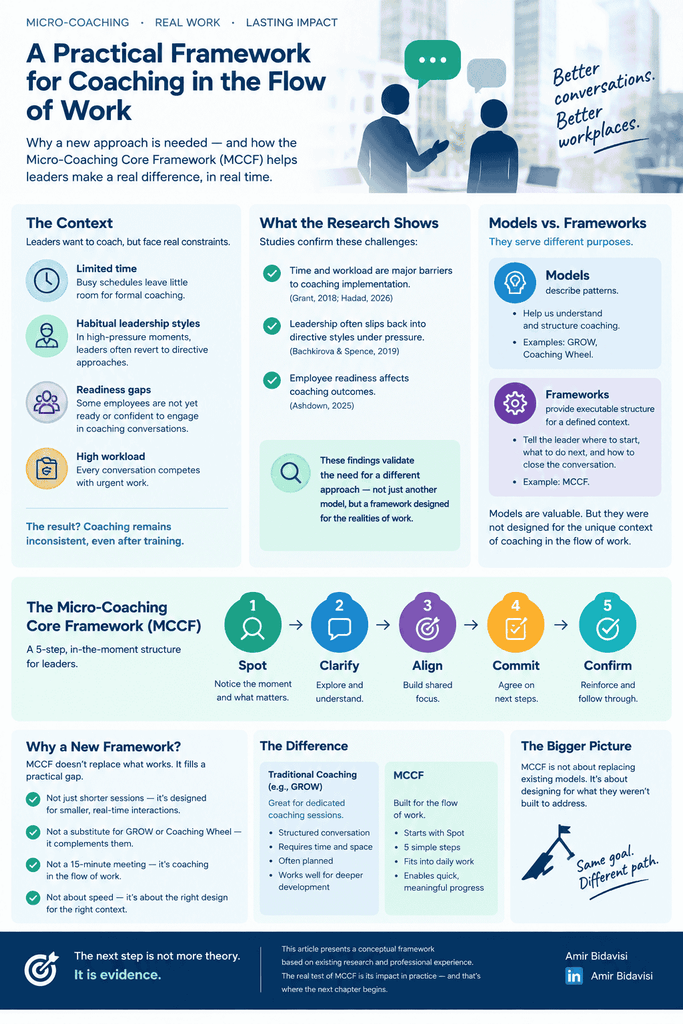
The Micro-Coaching Core Framework (MCCF) is designed specifically for brief, question-based leadership conversations that occur inside ongoing work—typically five to fifteen minutes. Its intended context is clear: the team member has sufficient authority and capability to act but needs greater clarity.
Rather than treating micro-coaching as a compressed version of a conventional engagement, MCCF organizes the interaction into five connected stages:
- Spot — Recognize the issue and decide whether coaching is appropriate.
- Clarify — Establish what actually needs attention.
- Align — Create shared orientation, explore options, and set direction.
- Commit — Translate the direction into a specific next action owned by the team member.
- Confirm — Ensure both parties understand the commitment and what happens next.
Together, the five stages provide an integrated response to these three barriers. The overall design accommodates time constraints by embedding coaching within ongoing work. Its structured sequence supports managerial capability by giving leaders a clear process to follow. Align and Confirm help establish shared understanding, clarify expectations, and support employee willingness to engage.
These stages form an integrated process for coaching in the flow of work. They keep the conversation focused, purposeful, and connected to action while respecting the realities of the leadership relationship.
Two brief examples illustrate how this distinction works in practice.
When coaching in the flow of work is appropriate
In the first, a team member reports that a project deadline is at risk. They have the authority and resources to address it but are uncertain how to prioritize. A short conversation helps them clarify the obstacle, weigh options, and commit to a next step. Coaching is appropriate.
When Coaching Is Not the Right Intervention
In the second, another team member faces the same deadline risk because a required resource can only be authorized by the leader. Further exploration will not remove the constraint. The leader addresses the resource issue directly. Coaching may become useful later; it is not the immediate intervention.
Conclusion — Why Coaching in the Flow of Work Needs Its Own Design
The case for a different framework is not that traditional models lack value. It is that coaching in the flow of work presents a distinct design challenge. Leaders need a process that fits limited time, organizes capability into an executable sequence, respects the managerial relationship, establishes shared orientation, recognizes when coaching is appropriate, and moves the conversation toward action.
MCCF is offered as one response to those requirements. Its usefulness must be tested through practical application: whether leaders find it usable, whether it is adopted in everyday work, and whether it produces clearer commitments.
The next step is not more theory. It is evidence.
References
Carter, A., Blackman, A., Hicks, B., Williams, M., & Hay, R. (2017). Perspectives on effective coaching by those who have been coached. International Journal of Training and Development, 21(2), 73–91. https://doi.org/10.1111/ijtd.12098
Carvalho, C., Kurian, P. O., Carvalho, S., & Carvalho, F. K. (2023). Managing managerial coaching: The role of stakeholders. Industrial and Commercial Training, 55(2), 295–305. https://doi.org/10.1108/ICT-10-2021-0074
Kruger, F., & Terblanche, N. H. D. (2025). The coaching flipside: Factors underlying unsuccessful workplace coaching interventions and the implication for human resource development. Human Resource Development Quarterly, 36(2), 175–191. https://doi.org/10.1002/hrdq.21548
Passmore, J., & Fillery-Travis, A. (2011). A critical review of executive coaching research: A decade of progress and what’s to come. Coaching: An International Journal of Theory, Research and Practice, 4(2), 70–88. https://doi.org/10.1080/17521882.2011.596484
Pramana, I. (2026). Cascade of misalignment: Understanding coaching erosion in hierarchical organizations. Annals of Human Resource Management Research, 6(1), 21–38. https://doi.org/10.35912/ahrmr.v6i1.3240