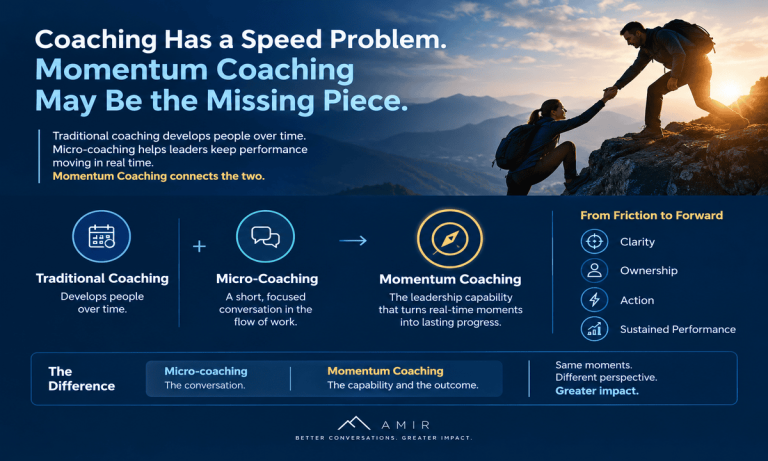

Most leaders intuitively know they should coach their teams more and solve problems less, yet the reality of daily operations often gets in the way. When a team member brings a problem, it is tempting to just hand them the answer to keep the workflow moving. However, waiting for a formal, scheduled coaching session means missing out on hundreds of valuable developmental moments. This is where micro coaching steps in—an agile, in-the-moment approach that allows HR and L&D professionals to equip leaders with the tools to build team ownership and capability during everyday work.
The True Definition of Micro Coaching
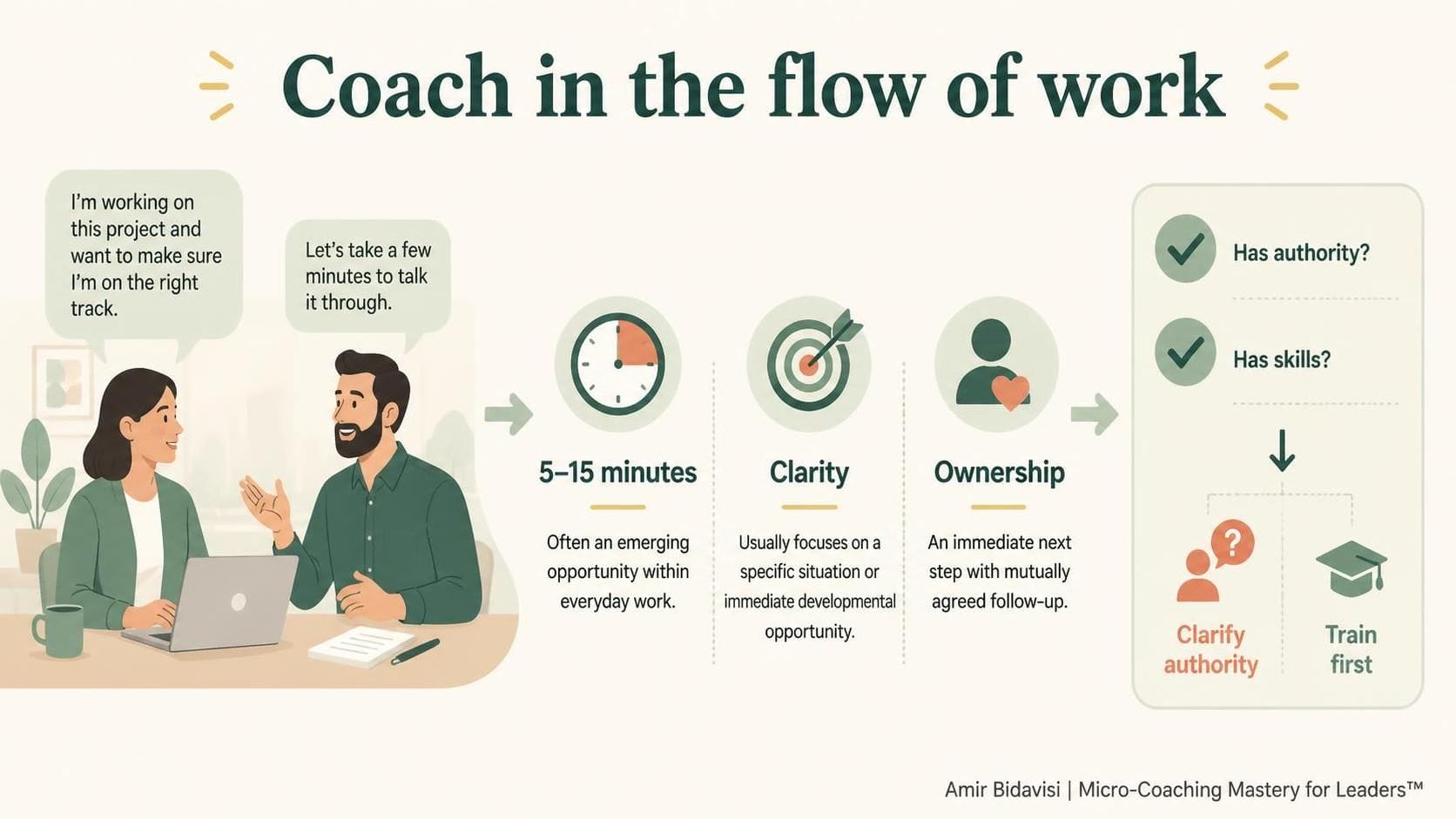
At its core, micro coaching is a short, question-based conversation—typically lasting between 5 and 15 minutes—that takes place in the flow of daily work. However, defining it merely by its brevity misses the point. Its true purpose and specific preconditions are what set it apart.
Micro coaching is designed to help a team member clarify a messy situation, take ownership of a challenge, and act independently. Crucially, it works best only when the employee already possesses the necessary authority and skills to act. If a team member lacks the authority to make a decision, the leader’s first step should be clarifying decision rights. If they lack the skills, direct instruction or training is required. Treating a skills gap or an authority issue as a coaching problem only creates unnecessary frustration. When the skills and authority are present, micro coaching creates the clarity and momentum needed to push the work forward.
Micro Coaching vs. Conventional Coaching
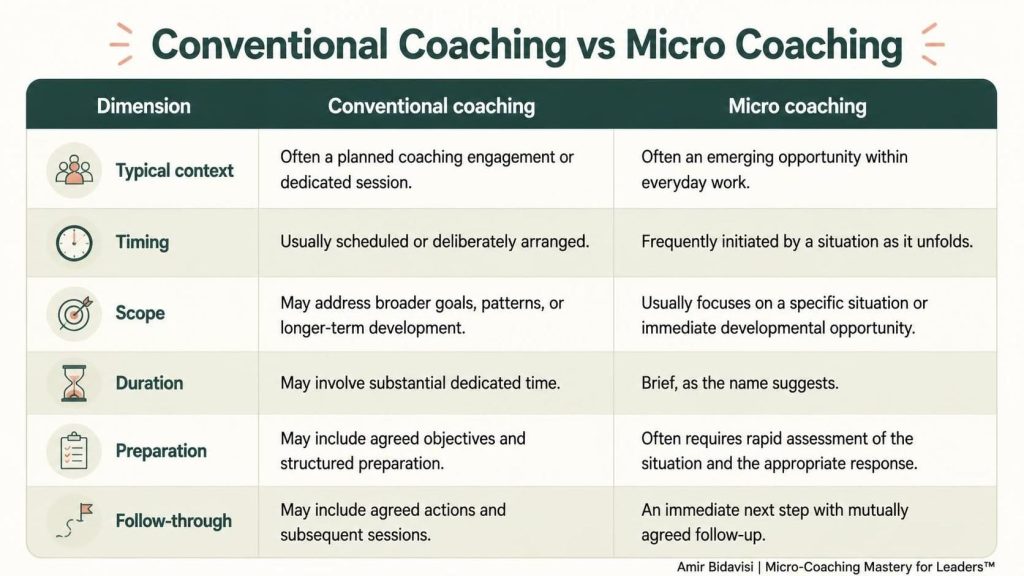
For L&D leaders designing leadership programs, it is vital to understand how this approach differs from traditional coaching. While both share the goal of fostering learning and development, their contexts vary significantly:
- Context & Timing: Conventional coaching is usually a planned, scheduled engagement. Micro coaching emerges naturally from everyday work, frequently initiated by a situation as it unfolds.
- Scope & Duration: Traditional coaching addresses broader career goals, patterns, and long-term development over substantial, dedicated time blocks. Micro coaching focuses on a specific, immediate situation and is brief.
- Preparation & Follow-through: Formal coaching involves structured preparation and agreed-upon objectives. Micro coaching requires rapid assessment of the situation and the appropriate response, ending with an immediate next step and a mutually agreed follow-up.
These are not rigid boundaries—a formal coaching session can be brief—but micro coaching is about making development possible exactly at the point where work presents a useful moment for learning. It is not about squeezing a full coaching session into five minutes.
How Micro Coaching Looks in Practice
The most common trap leaders fall into is replacing answers with questions for the sake of asking questions. Effective micro coaching is about creating progress while preserving the team member’s responsibility for the work.
Consider a team member who repeatedly escalates problems they could potentially resolve on their own. If the leader knows the employee has the experience but lacks confidence, handing over the solution is a missed opportunity. Instead, the leader might ask: “What options have you considered, and what makes this decision difficult?”
In less than ten minutes, this question creates space for the employee to examine the problem rather than transferring responsibility. The value is measured by whether the employee gains clarity, identifies a next step, or reveals a missing piece of information.
In a different context—such as a production line—if an operator makes a recurring mistake, a supervisor might need to give direct instruction if it is a safety or knowledge issue. But if the operator knows the procedure and simply hasn’t identified the root cause of the error, a brief developmental conversation is the appropriate intervention.
4 Pillars of Effective Micro Coaching
A brief conversation can feel constructive but still fail to produce meaningful progress. To ensure these moments lead to real action, leaders must master four key factors:
- Managing Mindsets and Readiness: Employees enter conversations in different states. Someone may be defensive, overwhelmed, or convinced only the leader has the answer. Leaders must recognize when the conditions do not support a developmental conversation and address immediate concerns or confusion first.
- Establishing Shared Alignment: Before exploring solutions, leaders must ensure they are discussing the same problem. The leader might assume the employee lacks confidence, while the employee is actually struggling with conflicting priorities. Both parties must agree on what needs attention.
- Adapting to the Work Context: A conversation about a delayed project requires a different approach than handling an immediate safety incident. Leaders must consider the task, the employee’s capability, the urgency, and the risk involved.
- Connecting the Conversation to Action: Insight alone does not guarantee progress. Before the brief conversation ends, there must be a clear next step. If a leader asks the team member to take ownership but subsequently takes the problem back, the practical message contradicts their stated intention.
The Micro-Coaching Core Framework (MCCF)™
Knowing when to coach is one thing; knowing how to handle the conversation when someone is stuck or defensive is another. To help leaders apply this reliably in the flow of work, a core framework is essential. A framework that is too vague offers little guidance, while one that is too rigid forces a script.
The Micro-Coaching Core Framework (MCCF) provides a practical, five-step structure that can be adapted to any operational environment:
- Spot: Moving from an event to a coaching opportunity. (e.g., “Pause. Tell me which part is unclear.”)
- Clarify: Moving from unclear to clear understanding. (e.g., “What outcome do you need today?”)
- Align: Moving from misalignment to shared direction. (e.g., “Which option gets you 80% there fastest?”)
- Commit: Moving from intention to ownership and action. (e.g., “What time will you execute the first step?”)
- Confirm: Moving from action to evidence of impact. (e.g., “When will you update me?”)
This rapid exchange takes less than ten minutes but successfully moves a team member from being stuck to taking ownership of the next step.
Conclusion: Development Within the Work
Micro coaching offers a powerful way to think about development beyond formal learning events. For HR and L&D professionals, the opportunity is to prepare leaders to recognize and use these everyday moments to build thinking, judgment, and ownership. The simplest next step for any leader is to notice one real conversation this week where they defaulted to solving the problem—and ask whether a different response was possible.
Ready to equip your leaders with the skills to coach in the flow of work? Visit the Micro Coaching Mastery course page to explore how the MCCF™ framework can transform your organization’s leadership capability.