

The case for micro coaching
Table of contents
You know the situation.
A team member brings you a problem that they could probably solve themselves.
Someone asks for a decision that should not need to come to you.
The same mistake appears again.
A training program has been completed, but the new behavior is not showing up at work.
A capable person gets stuck, and your first instinct is to step in and fix it.
These moments are small. But they happen repeatedly.
And every time a leader automatically provides the answer, takes over the problem, or makes the decision for someone else, an opportunity to develop capability and ownership may be lost.
This is where micro coaching becomes useful.
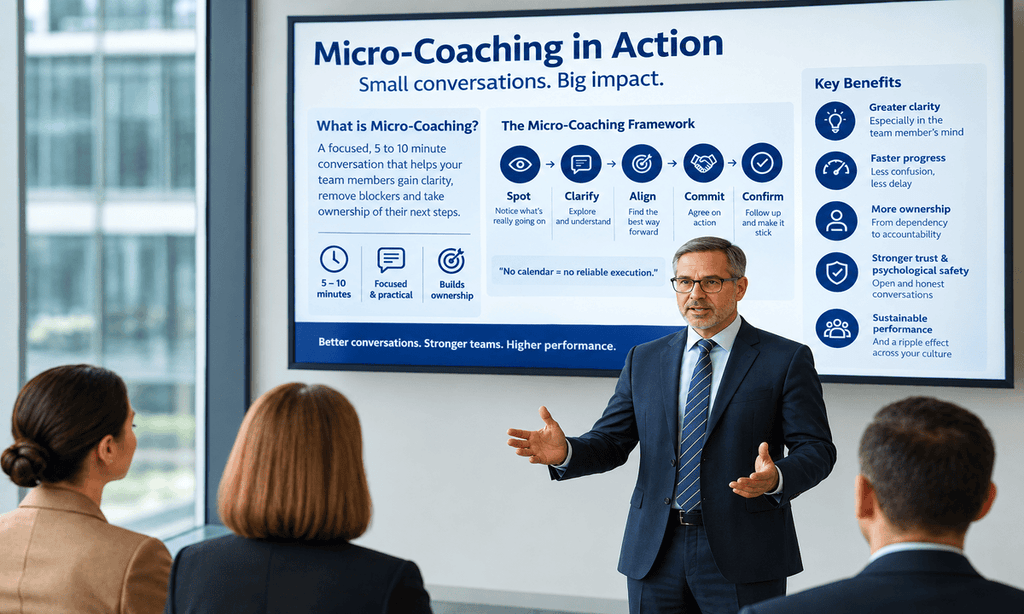
Micro coaching is the use of short, focused coaching interactions inside normal management work. It is not another meeting, another formal development process, or an attempt to turn every manager into a professional coach.
It is a way of using the moments that already occur in the workflow to create clarity, develop judgment, strengthen ownership, and maintain forward movement.
The research on workplace coaching provides a useful starting point. Meta-analyses have found positive effects of workplace coaching across organizational outcomes, although the research base is still developing and does not establish that every coaching approach works equally well.
That distinction matters.
The research cited in this article does not test my Micro-Coaching Core Framework (MCCF)™. It examines related areas such as workplace coaching, managerial coaching, psychological safety, and learning transfer.
MCCF is my practical synthesis for applying relevant coaching principles to short, structured conversations embedded in everyday management work.
The Hidden Cost: Managers Can Accidentally Take Ownership Away
There is another reason micro coaching matters.
Managers are often rewarded for solving problems quickly.
That instinct makes sense.
If something is broken, fix it.
If someone is stuck, help them.
If a decision is needed, make it.
But there is a difference between solving a problem quickly and building an organization that can solve problems without constant managerial intervention.
When a team member repeatedly brings problems upward and the manager repeatedly supplies the answer, a pattern can develop:
Problem → escalation → manager solution → temporary relief → another escalation
The manager becomes increasingly necessary.
The team member becomes increasingly dependent.
The manager may experience this as being helpful.
The organization may experience it as a capacity problem.
Micro coaching introduces another possibility:
Problem → conversation → thinking → ownership → action → follow-up
The purpose is not to withhold help.
It is to make the help developmental when the situation allows it.
Need transition
What Is Micro Coaching?
Micro coaching is a short, intentional developmental interaction that happens close to the moment when an issue, decision, behavior, or learning opportunity appears.
The emphasis is on micro.
The conversation may take only a few minutes.
The value does not come from making the conversation long. It comes from using the moment well.
A manager might use micro coaching when:
- someone is stuck on a problem
- a decision is unnecessarily escalated
- a mistake keeps recurring
- resistance appears
- a new skill is not being applied
- someone needs to think through a situation rather than receive another answer
- a successful outcome contains a lesson worth repeating
Micro coaching therefore sits between everyday management and formal development.
It brings development closer to the work itself.
Where Micro Coaching Creates Value
The potential value of micro coaching can be understood through several overlapping mechanisms identified in research on workplace coaching and related interventions.
| Situation | What may be happening | Potential value of micro coaching |
| Hidden blockers | Problems remain unclear until they become larger | Earlier clarification and problem resolution |
| Psychological resources | People may lack confidence, clarity, or perceived control | Greater self-efficacy and psychological resources |
| Relationships and psychological safety | People may hesitate to raise problems or ideas | More open conversations and willingness to contribute |
| Cultural spillover | Leadership behavior is repeated throughout the organization | More ownership-oriented management interactions |
| Learning transfer | Training knowledge does not automatically become workplace behavior | More opportunities to reinforce and apply learning |
| Manager development | Managers themselves need to develop judgment and coaching capability | Repeated practice inside normal work |
| Performance and engagement | Small problems and missed opportunities accumulate | Potential improvements in clarity, ownership, learning, and execution |
These categories should not be interpreted as seven separate promises.
Real management situations often involve several at once.
A recurring mistake may involve a capability gap, unclear expectations, low confidence, and a process problem simultaneously.
The analytical value of the categories is different: they help explain why a short coaching interaction might matter beyond the conversation itself.
What Micro Coaching Is — and Is Not
Micro coaching becomes clearer when it is distinguished from several other management interventions.
Micro Coaching vs. Advice
Advice gives someone your answer.
Micro coaching helps the person develop their own answer by responding to certain questions that lead their mind to solutions an a structured way in a short amount of time; when they have the capacity and authority to do so.
Advice can be exactly what is needed.
The point is not to eliminate it.
The point is to stop treating advice as the default response to every problem.
Micro Coaching vs. Training
Training develops knowledge or skill through a more deliberate learning process.
Micro coaching applies developmental interaction to a situation that is already occurring in the workflow.
A person may need training before they can perform a task.
Once they have the necessary capability, they may instead need a short conversation that helps them apply it.
Micro Coaching vs. Mentoring
Mentoring often involves sharing experience, perspective, and longer-term guidance.
Micro coaching is usually more immediate and situation-specific.
A mentor might explain how they handled a similar challenge.
A micro-coaching conversation might help the team member determine how they want to handle the current one.
Micro Coaching vs. Performance Correction
Sometimes the manager needs to be direct.
If a standard is clear and a person is not meeting it, the leader may need to address the performance issue explicitly.
Coaching should not become a way of avoiding accountability.
There are situations where the leader’s responsibility is to set expectations, correct behavior, make a decision, or take formal action.
Micro Coaching vs. Formal Coaching
Formal coaching typically involves a more deliberate coaching relationship, defined objectives, dedicated time, and a broader developmental process.
Micro coaching is intentionally smaller.
It is designed to fit inside ordinary leadership interactions.
The two are not competitors.
A leader can use micro coaching every day while participating in or providing more formal coaching when the situation requires it.
What the Micro-Coaching Mastery™ For Leaders Course Actually Adds
Take Micro Coaching From Concept to Practice
The course provides the implementation.
Micro-Coaching Mastery for Leaders builds the skill and places it inside a broader leadership operating system.
The course covers several layers around the micro-coaching in real-time.
Operating Principles
Leaders first establish the conditions under which coaching makes sense.
This includes understanding what it is designed to accomplish, what it is not designed to do, and how it fits alongside other forms of leadership intervention.
Choosing the Right Intervention
Not every problem is a coaching problem.
Sometimes a team member needs a clear instruction.
Sometimes they need training.
Sometimes they need information or advice.
Sometimes a performance issue requires direct correction.
The course helps leaders make that distinction rather than treating coaching as the answer to everything.
Recognizing Coaching Moments
The course develops the ability to spot opportunities in ordinary workflow.
The emphasis is not on waiting for a formal coaching session.
It is on recognizing the small moments in which a short conversation can create more clarity, ownership, learning, or forward movement.
Applying Micro coaching in Real Situations
This framework is only useful when leaders can apply its logic to different workplace situations.
The course therefore moves beyond the abstract sequence and into practical application: what the leader is noticing, what needs clarification, where the conversation should go, and what meaningful commitment looks like in context.
Reading Readiness
The same intervention does not work equally well with every person in every situation.
The course includes a practical approach to assessing readiness and adjusting the conversation accordingly.
The objective is not to label people.
It is to help the leader decide how much structure, clarity, challenge, or support the situation requires.
Troubleshooting
Real conversations do not always follow the ideal path.
The course addresses common points where leaders lose momentum: conversations that become vague, people who repeatedly return for answers, ownership that does not appear, or discussions that feel productive but produce no action.
This is where a framework becomes more useful than a list of questions.
Building the Habit
Finally, the objective is not to make leaders perform “coaching conversations.”
It is to make small developmental interventions part of how they work.
The long-term value comes from recognizing these moments more consistently and responding to them deliberately.
From Micro Conversations to a Leadership Practice
The purpose is not to make every conversation deeper.
It is about making certain conversations more useful.
A short interaction can clarify a problem, develop judgment, reinforce learning, or return ownership to the person who should have it.
But that requires more than good intentions and more than a collection of powerful questions.
It requires a repeatable way to recognize the moment, structure the interaction, and close the loop.
A good coaching question can open a conversation. A framework helps close the loop.
That is the thinking behind the Micro-Coaching Core Framework™ and the foundation of Micro-Coaching Mastery for Leaders.
From Micro Conversations to a Leadership Practice
If you want to move beyond individual coaching questions and learn how to implement micro coaching as a repeatable leadership practice, Micro-Coaching Mastery for Leaders provides the full system.
The course takes teaches leaders how to recognize coaching moments, choose the appropriate intervention, adapt to the situation, apply the framework, handle common failure points, and build the behavior into everyday work.
The goal is straightforward:
Stop Solving Every Problem. Start Building Momentum.
Click here and learn more about Micro-Coaching Mastery Course for Leaders.




[…] Micro Coaching Mastery for Leaders […]