
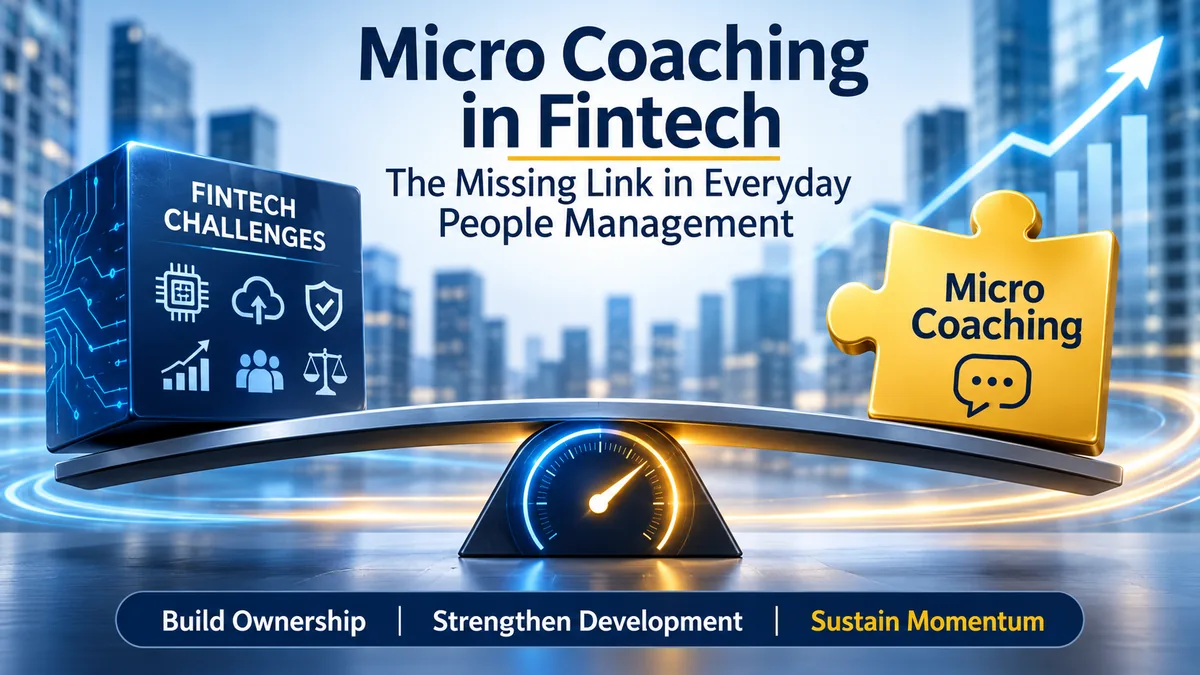
Fintech moves fast. Does people management keep up?
Micro coaching in fintech addresses a growing challenge facing technology-driven financial businesses: the gap between the pace of operational work and the responsiveness of everyday people management.
Fintech companies compete in an environment defined by technological change, demanding customers, continuous innovation, and pressure to deliver results. They must move quickly while maintaining the reliability, accountability, and regulatory standards expected of financial services businesses.
Yet there is a critical question behind this operational intensity: Are their people-management practices keeping pace?
The challenge goes beyond attracting technical talent or implementing modern HR systems. It concerns how managers lead different workforce segments, coordinate distributed teams, develop professional capabilities, retain valuable employees, and maintain performance under pressure.
Fintech companies inherit some of these challenges from the technology sector. They also face additional pressures arising from the particular demands of financial services.
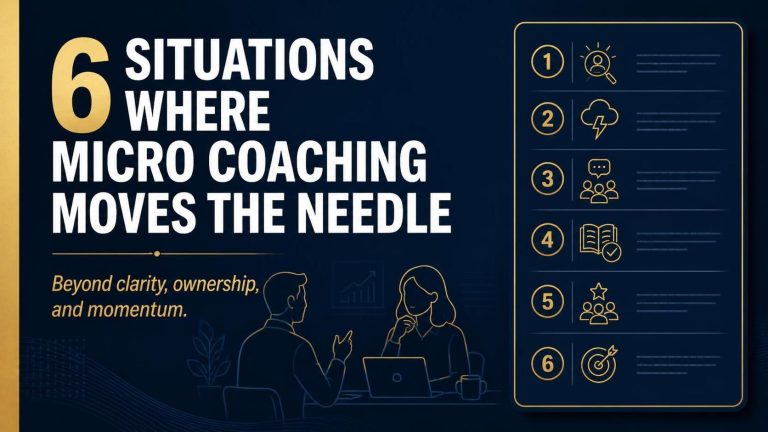
Together, these realities create six significant people-management challenges. Understanding their combined impact is essential to understanding why conventional management approaches are no longer sufficient on their own—and why micro coaching in fintech deserves serious consideration as a practical management approach.
Three Structural Realities Inherited from Technology Businesses
Fintech companies share three fundamental workforce and management challenges with the wider technology sector.
1. Different Workforce Levels, Different Management Needs
Technology businesses bring together professionals with different levels of experience, expertise, and organizational responsibility.
Junior, mid-level, and senior employees do not have identical management needs.
Junior professionals require direction, feedback, and opportunities to build competence. Mid-level professionals face increasing demands for independent decision-making, prioritization, and cross-functional coordination. Senior professionals require greater autonomy, strategic clarity, and opportunities to contribute beyond their immediate responsibilities.
Managing all three groups through the same management approach creates a mismatch between what employees need and what managers provide.
Effective people management requires situational judgment: understanding the individual’s level of responsibility, recognizing the challenge they face, and providing the appropriate form of support.
2. Remote and Hybrid Work
Remote and hybrid working arrangements have fundamentally changed managerial interaction.
Managers no longer have the same opportunities for informal conversations, direct observation, and immediate clarification that traditional office environments provide. Communication gaps become harder to identify, misunderstandings can persist, and small coordination problems can develop into operational difficulties.
The challenge is not simply keeping employees connected through digital communication tools. It is maintaining clarity, accountability, coordination, and meaningful managerial interaction across distributed teams.
Without deliberate attention, distance weakens the connection between individual responsibilities and shared organizational priorities.
3. Scarce Technical Talent
Technology businesses operate in a competitive market for specialized expertise.
Finding professionals with the right technical capabilities is difficult, and replacing experienced employees creates costs that extend well beyond recruitment. Organizations lose accumulated knowledge, technical continuity, project experience, and established working relationships.
This creates a management responsibility that begins after recruitment.
Organizations need to develop existing capabilities, retain institutional knowledge, and create working environments in which skilled professionals can continue contributing and growing.
Recruitment brings talent into the organization. Effective people management helps retain its value.
Three Additional Pressures in Fintech
Fintech inherits these structural challenges but operates under additional pressures that make people management more demanding.
Its employees must perform in a fast-changing technological environment while meeting the reliability, accountability, and control requirements of financial services.
Three additional pressures stand out.
4. Sustained Performance Pressure and Employee Burnout
Fintech professionals operate under continuous performance demands.
Product releases, technical changes, customer expectations, operational deadlines, and competitive pressures create an environment in which maintaining performance is an ongoing requirement rather than an occasional objective.
The consequences for employees are significant.
The Fintech Talent in Motion – Global 2026 report, published by PCN and FIBE, found that 28.6% of surveyed fintech professionals experience frequent burnout.
This finding highlights an important management issue. Sustained performance cannot be achieved simply by continuously increasing expectations.
Managers must recognize signs of pressure, address emerging difficulties, and distinguish between situations requiring managerial support and those demanding changes to workload, resources, or organizational priorities.
Burnout is not simply an individual resilience problem. It is also influenced by the conditions under which people work and the quality of management they experience.
5. Talent Retention, Career Progression, and Development
Competition for fintech talent does not end when an organization fills a vacancy.
Retaining experienced professionals requires more than competitive compensation. Employees need credible opportunities to develop, take on greater responsibilities, and see a meaningful future within the organization.
The PCN and FIBE research reveals an important distinction between the factors that drive employees away and those that attract them to new opportunities.
62.9% of respondents identify a lack of career progression as their main reason for leaving their current organization. Meanwhile, 68.1% identify salary as a key factor when considering a new role.
These findings describe two different career decisions, and their implications should not be confused.
Salary matters in attracting talent, but the absence of professional progression is a major retention problem. Organizations that concentrate exclusively on compensation risk overlooking the conditions that encourage experienced employees to stay.
The report reveals another significant gap: 77% of respondents are dissatisfied with their existing Learning & Development offerings.
This finding raises questions about the connection between formal learning and actual professional growth.
Training programs have an important role, but professional development cannot be confined to occasional learning events. Employees also need opportunities to apply knowledge, improve judgment, develop independent decision-making, and take greater responsibility through their everyday work.
For fintech organizations, talent retention and development must therefore become part of everyday management, not merely an HR program.
6. Operational Momentum Under Risk and Compliance Constraints
Fintech companies face a demanding operational requirement: maintaining speed without compromising control.
Unlike many technology businesses, fintech organizations operate within financial services environments where operational decisions carry significant implications for risk, accountability, data protection, and regulatory compliance.
Managers must maintain delivery momentum while ensuring that employees understand their responsibilities, respect established boundaries, and make decisions at the appropriate level of authority.
This creates a particularly demanding management environment.
Excessive managerial intervention slows execution and creates unnecessary dependency. Insufficient direction, on the other hand, creates uncertainty, weakens accountability, and exposes the organization to operational risks.
The challenge is to develop employees who can think independently, take ownership, and act decisively within clearly defined responsibilities.
That requires more than technical competence or procedural knowledge. It requires effective everyday people management.
Six Challenges, One Underlying Management Problem
The six challenges reveal a common organizational requirement.
Fintech managers must work with different levels of professional maturity, maintain effective relationships across distributed teams, develop scarce talent, respond to sustained performance pressure, support career progression, and preserve operational accountability.
These responsibilities cannot be managed effectively through occasional interventions alone.
Formal performance reviews, scheduled one-to-ones, training programs, and conventional development initiatives remain important. However, they operate at intervals, while the challenges managers need to address emerge continuously.
Consider what happens during an ordinary working week.
A developer struggles with competing priorities. An operations employee repeatedly makes the same mistake. A team member misses a delivery commitment. A capable professional hesitates to make a decision. A project encounters coordination problems between departments.
Each situation requires managerial attention.
Yet managers frequently respond in one of two ways: they step in and provide the answer, or they postpone the discussion until a scheduled meeting.
The first approach creates dependency. Employees become accustomed to relying on managers to solve problems they are capable of handling themselves.
The second delays intervention. Uncertainty continues, small problems become recurring patterns, and opportunities for development are missed.
This creates a gap between the pace of operational work and the responsiveness of people management.
The central problem is not a shortage of management activities. It is the absence of an effective way to make everyday managerial interactions more purposeful and productive.
Why Micro Coaching in Fintech Must Move Into the Flow of Work
Traditional management practices are not inherently ineffective. Their limitation is that they cannot address every people-related challenge at the point where it emerges.
A performance review provides an opportunity to evaluate past results. A training program develops knowledge and skills. A formal one-to-one creates space for broader discussions. Each serves a legitimate purpose.
But none of these automatically ensures that managers respond effectively to the everyday situations influencing employee performance and development.
In fast-moving environments, the distance between an emerging problem and an appropriate managerial response matters.
When a team member lacks clarity, delaying the conversation does not make the uncertainty disappear. When an employee repeatedly encounters a problem, another general reminder does not necessarily improve their judgment. When a capable professional relies excessively on managerial direction, providing more answers reinforces the very dependency the organization needs to reduce.
Effective people management must therefore become more closely connected to the work itself.
Managers need practical ways to recognize situations that require attention, engage employees in purposeful conversations, and support progress without unnecessarily taking over responsibility.
This is the context in which micro coaching in fintech becomes relevant: bringing structured management conversations closer to the situations that demand managerial attention.Micro Coaching in Fintech: A Practical Approach to Everyday People Management
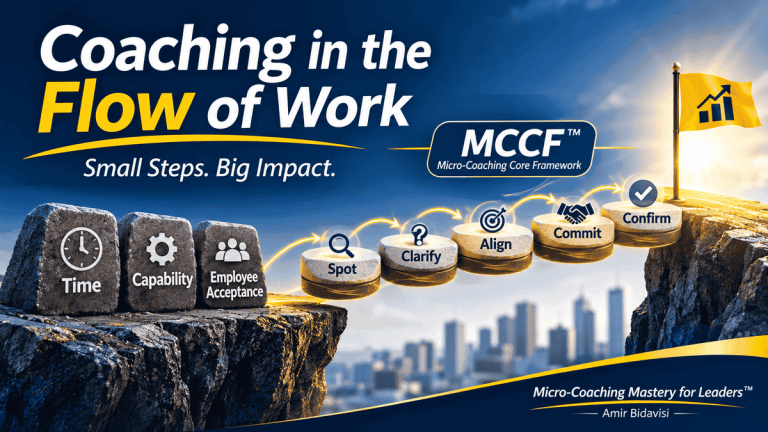
Micro Coaching is a small-by-design, structured conversational management approach built for everyday work.
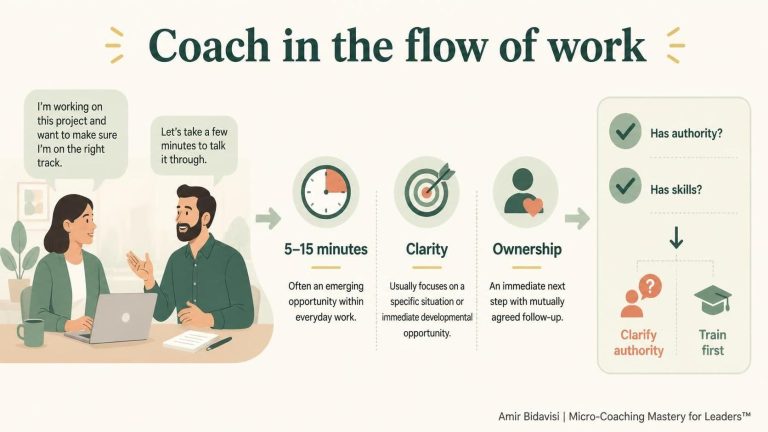
It uses brief, purposeful conversations, typically lasting 5–15 minutes, to help employees develop clarity, take ownership, and identify appropriate next actions in real work situations.
Its starting point is not a separate coaching objective or a scheduled developmental session. It is an actual workplace situation that requires attention.
A missed deadline, an unclear responsibility, a recurring mistake, a difficult interaction, a decision-making challenge, or an opportunity for professional development can all provide the context for a micro coaching conversation.
The distinction is important: Micro Coaching is not conventional coaching compressed into fewer minutes. It is designed around a different managerial context and purpose.
The conversation is short because its scope is deliberately focused. It addresses a specific situation connected to existing work rather than creating another separate activity in an already demanding schedule.
When employees have the necessary skills and authority but need greater clarity in their thinking, managers can use these conversations to help them examine the situation, consider their options, and take responsibility for appropriate action.
Instead of automatically supplying solutions, managers support employees in developing their own responses.
This changes the quality of managerial interaction.
It moves managers away from solving every problem themselves and toward developing greater independence and ownership within their teams.
For organizations examining micro coaching in fintech, this is the central management proposition: improve the quality of everyday conversations without adding unnecessary meetings or creating another layer of management activity.
Where Micro Coaching in Fintech Makes a Difference
Micro Coaching applies across different functions and levels of a fintech organization because its focus is not a particular technical discipline. Its focus is the quality of everyday managerial interaction.
In product and technology teams, it supports conversations around priorities, delivery commitments, coordination, problem-solving, and independent decision-making.
In operations and customer-facing functions, it provides a practical approach to recurring mistakes, communication difficulties, service challenges, and accountability for outcomes.
In risk and compliance functions, it supports employee thinking, role clarity, and ownership within established policies, controls, and decision-making boundaries. It does not replace mandatory procedures, formal controls, or escalation requirements.
In remote and hybrid teams, it makes purposeful managerial conversations part of regular work-related interaction, helping employees maintain clarity and accountability despite physical distance.
For professional development, it connects learning with actual responsibilities. Employees gain opportunities to reflect on their decisions, strengthen their judgment, and take greater ownership of their work.
Across all these applications, the objective remains consistent: make people management more responsive to the situations that shape performance and development.
This is what makes Micro Coaching relevant to the different workforce realities and operational pressures facing fintech organizations.
A More Effective Management Approach, Without Replacing Management
Micro Coaching is not a universal solution to every workforce challenge facing fintech companies.
It does not replace technical training when employees lack the necessary capabilities. It does not resolve inadequate staffing, unrealistic workloads, uncompetitive compensation, or the absence of genuine career opportunities. Those issues require direct managerial and organizational action.
Nor does it replace formal performance management, regulatory controls, or managerial authority.
Its value lies in addressing a specific and often overlooked gap: the quality, timing, and effectiveness of everyday conversations between managers and employees.
Managers need to recognize when coaching is appropriate and when a situation requires instruction, direct intervention, additional resources, or a change in organizational arrangements.
This distinction is fundamental.
Coach thinking. Manage authority.
When employees have the capability and authority to act but lack clarity, managers need an effective way to support their thinking and strengthen ownership.
That is the management challenge Micro Coaching addresses.
The objective is not to turn every managerial interaction into coaching. It is to make the right conversations more effective.
Conclusion: People Management Must Keep Pace With Fintech
Fintech companies invest heavily in technology, infrastructure, product development, and talent acquisition. But organizational performance depends on more than the quality of these investments.
It also depends on how effectively managers lead, support, develop, and engage the people responsible for delivering results.
The six challenges facing fintech organizations make this responsibility particularly demanding. Different workforce needs, distributed teams, scarce technical talent, sustained performance pressure, retention and development expectations, and the need to maintain operational momentum under strict controls all place greater demands on everyday people management.
Traditional management practices remain necessary, but they need to be complemented by approaches designed for the realities of modern work.
Micro coaching in fintech brings structured, purposeful people-management conversations into the flow of work. It helps managers build clarity, strengthen employee ownership, encourage professional development, and maintain follow-through without creating unnecessary meetings or taking responsibility away from employees.
For fintech organizations, this is not simply another coaching technique. It is a practical way to strengthen the management capability that connects people, performance, and execution.
Fintech moves fast. People management must move with it.
Bring Micro Coaching Into Your Organization
Micro Coaching provides managers with a practical approach to improving everyday people management and developing greater ownership across their teams.
I work with organizations to introduce this approach in the context of their management challenges, workforce structure, and operational requirements.
Contact us to discuss how Micro Coaching in Fintech can be applied within your organization.
Better People Management. Stronger Ownership. Sustained Momentum.