

When Micro Coaching Situations Deliver the Greatest Impact
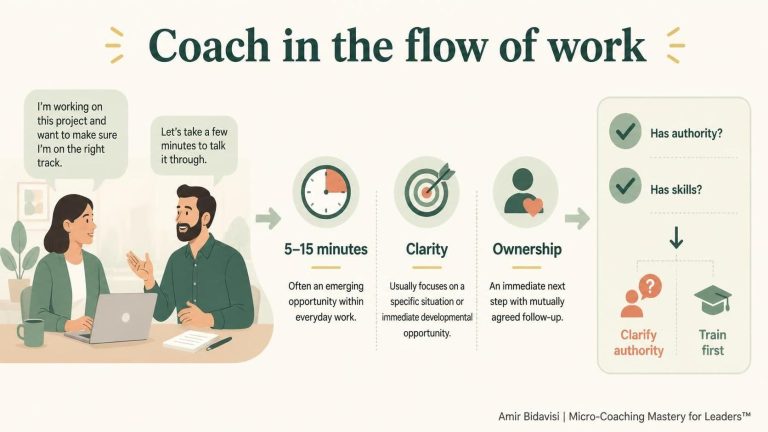
Beyond clarity, ownership, and momentum, certain workplace moments demand something more precise than traditional coaching. These are the micro coaching situations where short, focused conversations create outsized results. Micro coaching—brief, intentional 5–10 minute interactions—works best when applied deliberately. Not every challenge needs a formal session. The real leverage appears in specific contexts where timing, frequency, and low pressure matter more than duration.
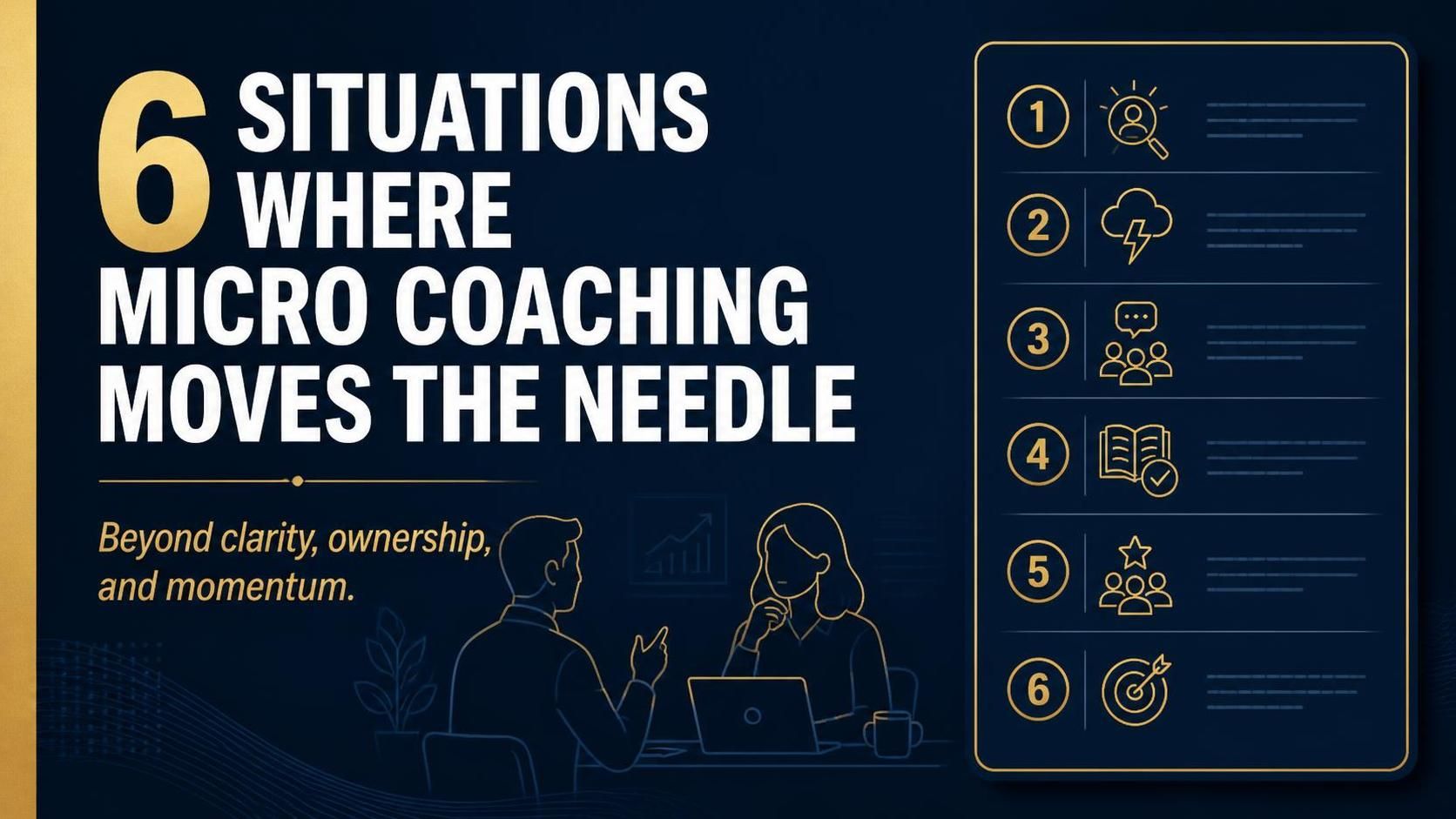
Understanding these micro coaching situations helps leaders stop treating coaching as a nice-to-have and start treating it as operational infrastructure. Below are six high-impact contexts where micro coaching consistently delivers measurable progress.
1. Early Detection of Hidden Blockers in Micro Coaching Situations
New hires, people moving into new roles, and teams with recurring low-performance pockets often carry invisible friction. Role ambiguity, confidence gaps, or quiet negative anchors rarely surface in scheduled performance conversations. By the time they appear in metrics or quiet quitting, the cost is already high.
In these micro coaching situations, short informal check-ins lower the psychological threshold. A manager can ask a simple question after a meeting or during a brief walk: “What’s feeling unclear right now?” or “Where are you second-guessing yourself?” Because the interaction is short and non-evaluative, people name issues they would otherwise hold back. Early detection prevents small problems from compounding into errors, disengagement, or attrition. Formal one-on-ones often arrive too late; micro moments catch the signal while it is still easy to address.
2. High-Stress or Change Environments
Change initiatives, tight deadlines, and high-pressure operations drain psychological capital. Self-efficacy, optimism, hope, and resilience erode quickly under sustained stress. Traditional coaching programs add another meeting to already overloaded calendars and rarely match the real-time need.
Micro coaching fits because brief guidance compounds without creating extra program load. A two-minute conversation before a difficult presentation, a quick reframing after a setback, or a focused question during a tense project review can restore a sense of agency. These micro coaching situations build psychological resources in the moment rather than after the pressure has already taken its toll. Leaders who embed short coaching interactions into the flow of high-stakes work help their teams stay functional longer and recover faster.
3. Micro Coaching situations for Remote, Hybrid, or Feedback-Averse Cultures
Distributed teams, diverse groups, and environments where feedback feels evaluative create distance. Transactional interactions become the default. People protect themselves by staying surface-level. Formal feedback sessions often reinforce that dynamic instead of shifting it.
Frequent, brief micro coaching changes the texture of the relationship. When interactions are short and framed as support rather than judgment, openness grows over time. A manager who regularly asks “What would make this next step easier?” or “What’s one thing that would help you feel more solid here?” signals care without the weight of a performance conversation. In these micro coaching situations, frequency plus brevity gradually moves the culture from transactional to supportive. Trust accumulates through many small positive contacts rather than one high-stakes review.
4. Post-Training or Skill-Building in the Flow of Work
Formal training delivers knowledge. The forgetting curve and the gap between classroom and real application quietly erase most of it. Organizations rarely have bandwidth for extra practice sessions weeks later.
Micro coaching counters this by delivering spaced, timely reinforcement exactly when the skill is needed. After a training on difficult conversations, a manager can pause a team member before a real client call and ask two precise questions that activate the new skill. During skill application itself, a short coaching moment turns theory into habit. These micro coaching situations close the transfer gap. Learning sticks because reinforcement arrives in context, not in a separate review meeting that feels disconnected from daily work.
5. Scaling Coaching Across Frontline and Mid-Level Managers
Resource-constrained organizations, operations-heavy settings, and large numbers of frontline supervisors cannot run traditional coaching programs at scale. Time, budget, and managerial bandwidth are limited. Yet these layers of leadership influence the largest number of employees.
Micro coaching is one of the few formats that remains both affordable and practical at scale. Conversations stay under ten minutes. Managers develop their own coaching capability and confidence through repeated short practice rather than lengthy certification programs. When every supervisor can run effective micro conversations, coaching capacity multiplies without requiring a proportional increase in specialist coaches or training budgets. In these micro coaching situations, the constraint itself becomes the design brief: keep it short enough that busy managers will actually do it.
6. Cultural Modeling and Spillover
Building a coaching culture requires more than workshops and posters. Peer observation and leadership behaviors that cascade matter more. Teams adopt what they see leaders do consistently, not what leaders announce in town halls.
Visible, frequent micro-moments create new norms faster than formal programs. When managers regularly demonstrate curiosity, ask good questions, and treat learning as normal in public view, people copy the pattern. A leader who pauses in a meeting to coach a colleague openly models continuous learning. These micro coaching situations generate spillover: the behavior spreads because it is observable and frequent. Culture shifts through repeated small demonstrations rather than through one-off events that fade.
Turning Micro Coaching Situations into Leverage
These six micro coaching situations share a common pattern. They occur where formal structures are too slow, too heavy, or too infrequent to match the real need. Micro coaching succeeds because it matches the constraint: limited time, high volume of interactions, and the requirement for psychological safety.
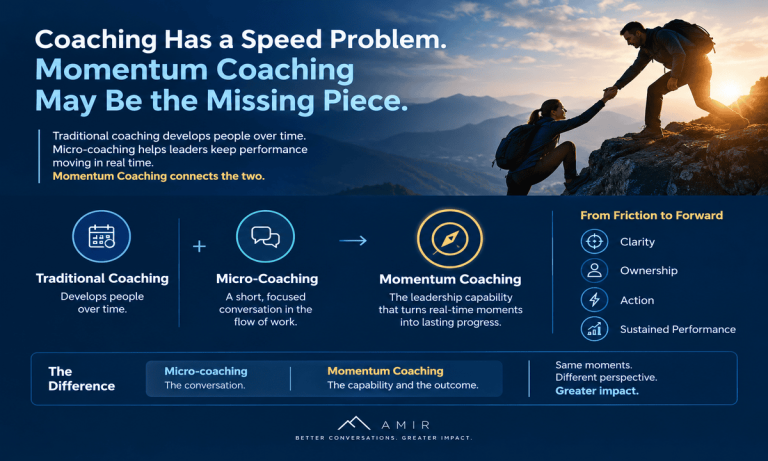
Clarity, ownership, and momentum remain essential outcomes of good coaching. Yet the situations above show where micro coaching moves beyond those foundations into operational leverage—detecting problems early, protecting psychological capital under pressure, building trust in distributed environments, locking in skill transfer, scaling capability affordably, and accelerating cultural change.
Leaders who recognize these contexts stop waiting for perfect conditions or larger programs. They insert short, focused conversations into the existing flow of work. The result is not more coaching meetings. It is more effective influence at the moments that actually determine performance, retention, and culture.
Ready to apply these micro coaching situations in your real leadership work?
Micro-Coaching Mastery for Leaders gives you the complete system to turn short, focused conversations into consistent results. You’ll get the full video course, a downloadable implementation kit, and practical tools designed for busy managers who need coaching that fits into the flow of work—not another long program.
Start building ownership, improving accountability, and developing your people through focused 5–10 minute coaching conversations.