

How managers can use behavioral cues to identify potential obstacles
Micro coaching training helps managers recognize potential obstacles in everyday workplace conversations before they become bigger problems. When a team member says, “I understand,” but the task still does not move forward, or responds with “It’s complicated” without explaining why, the words alone may not reveal what is getting in the way.
For managers, these moments present a practical challenge. The words alone may not reveal what needs attention, yet jumping to conclusions can lead to the wrong intervention.
Micro coaching training can help managers develop a more structured way to notice potential obstacles, explore them through questions, and help team members move towards action. One useful starting point is to pay attention to changes in facial expression, posture, and language before deciding what to ask.
Why Managers Need to Look Beyond Words
Everyday workplace conversations contain more information than people express directly. A team member may struggle to articulate a concern, assume something about a colleague’s reaction, or lack clarity about the next step.
Managers often respond by explaining the task again, offering advice, or taking over the problem. These interventions may be appropriate, but they can also miss the actual obstacle.
The alternative is to pause before solving the problem. Notice what has changed, identify something worth exploring, and ask a question that helps the team member explain the situation.
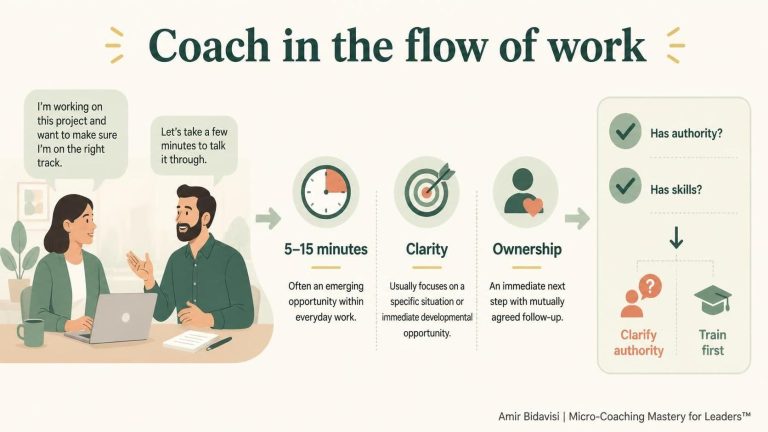
This is particularly useful when the person already has the authority and skills to act independently. The purpose is not to turn every interaction into a formal coaching session. It is to make brief conversations more productive without unnecessarily slowing down the work.
What Cognitive Load Means in Everyday Leadership
Cognitive load refers to the demands placed on working memory while someone processes information, makes sense of a situation, or works through a task.
In the workplace, a person may be dealing with unfamiliar information, competing priorities, an unclear instruction, or several decisions at once. These demands can make it harder to explain an issue, evaluate options, or decide what to do next.
A manager does not need to diagnose someone’s cognitive load. The practical task is to recognize when a conversation may require clarification rather than another instruction.
For example, if someone repeatedly gives vague answers about a task, the issue may not be a lack of commitment. They may be uncertain about a requirement, concerned about a consequence, or trying to manage too many demands simultaneously.
The useful question is not, “What is wrong with this person?” but, “What might be getting in the way of progress?”
The Spotting Triad: Face, Posture, and Words
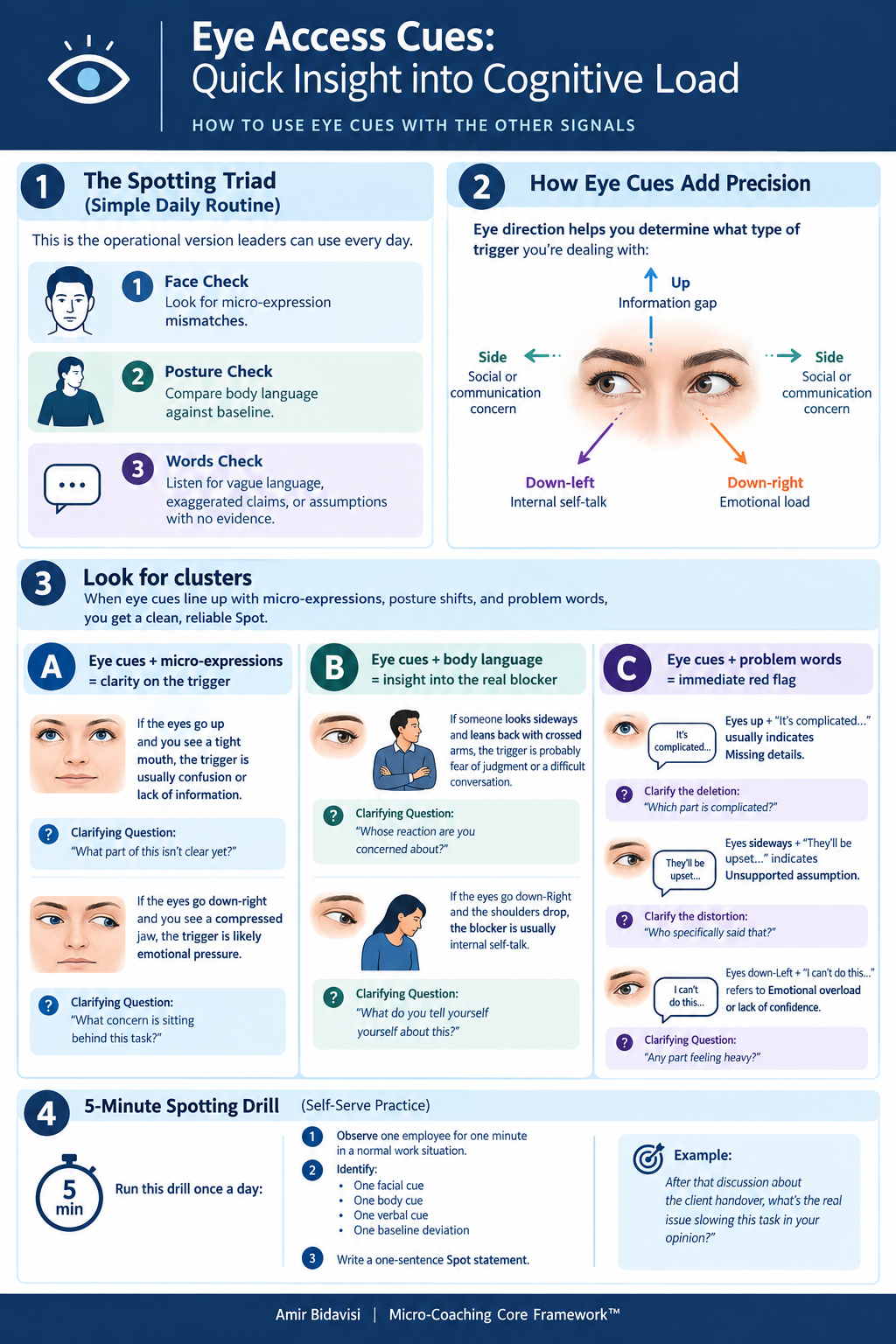
I developed the Spotting Triad as part of my Micro-Coaching Core Framework™ (MCCF™). It brings three sources of information together to help leaders identify potential obstacles worth exploring.
Face: Notice changes in facial expression.
Look for changes that occur during a conversation, such as a tightened mouth, a furrowed brow, or a brief expression that differs from the person’s usual presentation. The change may indicate that something deserves attention, but it does not explain what that something is.
Posture: Compare body language with the person’s baseline.
Notice changes in posture, movement, or physical engagement. Someone who usually leans forward may suddenly lean back; someone who normally speaks with energy may become still. A meaningful change from their usual behavior can provide a reason to ask a question.
Words: Listen for patterns in language.
Pay attention to vague explanations, unsupported assumptions, exaggerated claims, and statements that leave important details unspecified.
For example:
- “It’s complicated.” What part is complicated?
- “They’ll be upset.” Who specifically is expected to react that way?
- “I can’t do this.” What, specifically, feels difficult to do?
Together, these three sources help leaders notice potential obstacles that may otherwise go unaddressed. The next step is to explore what they have noticed rather than assume they already know the cause.
From Spotting to Clarifying
Spotting is the entry point, not the outcome. The Spotting Triad helps a leader identify a possible obstacle worth exploring. The next stage of the Micro-Coaching Core Framework™ is Clarify: establish what is actually happening, distinguish the real issue from initial assumptions, and determine what needs attention before considering a way forward.
The leader does not need to get the initial interpretation right. The leader needs to ask a question that helps the team member identify and explain the issue.
Suppose a team member becomes quieter after a discussion about a client handover and then says, “It’s complicated.”
Rather than interpreting the behavior or immediately offering a solution, the leader might ask:
“After that discussion about the client handover, what’s the real issue slowing this task, in your view?”
The response provides information that observation alone cannot. It may reveal a missing decision, an unresolved disagreement, an unclear responsibility, or something else entirely.
The leader can then explore the actual issue instead of solving the wrong problem.
How Eye-Access Cues Can Guide Better Questions
In NLP Business Coaching, eye-access cues are used as prompts for exploring what someone may be processing during a conversation. The traditional directional categories offer possible questions to consider:
- Up: Is there information the person still needs to work through?
- Side: Is there a communication concern or another person’s reaction worth exploring?
- Down-right: Is there a concern or emotional pressure the person wants to discuss?
- Down-left: Is the person working through internal dialogue or questioning their ability to act?
These categories should not be treated as established indicators of specific thoughts or emotional states. Research has not established that a particular direction of eye movement reliably reveals a particular mental process. Eye movements vary between people and situations, and direction alone cannot establish what someone is thinking.
The practical value lies in the question that follows, not in assigning meaning to the gaze.
For example, rather than assuming that an upward glance means someone lacks information, a manager might ask, “Is there anything you still need to clarify before moving forward?”
Used this way, eye-access cues remain a secondary observation within a broader process that combines facial expressions, posture, language, context, and direct questions.
Why Clusters Are More Useful Than Isolated Signals
A single behavioral change can be ambiguous. Looking at several signals together can provide a more useful reason to explore an issue.
Consider these examples:
Possible confusion: A team member looks upward, tightens their mouth, and says, “I think I follow.” A useful question might be: “Which part would be worth going through once more?”
Possible concern: Someone’s jaw tightens after a discussion about a deadline, and they become less engaged. Ask: “Is there a concern about the deadline that we haven’t discussed yet?”
An unsupported assumption: A team member leans back and says, “They’ll never agree to this.” Ask: “What makes you expect that reaction?”
In each case, the observations help the leader choose a question. They do not establish the explanation in advance.
In each case, the cluster helps the leader decide what to explore, while the team member’s response provides the missing context.
A Five-Minute Spotting Drill for Managers
Practice once a day during an ordinary work interaction.
Step 1: Observe for one minute.
Notice one facial cue, one body-language cue, and one verbal cue.
Step 2: Compare with the person’s baseline.
Identify one meaningful change in their usual behavior or communication.
Step 3: Form a tentative Spot statement.
Ask yourself what might be getting in the way of progress.
Step 4: Test your observation with a question.
For example, after noticing hesitation during a discussion about a project deadline, a leader might ask:
“What’s the main thing that could prevent us from meeting this deadline?”
Listen to the answer and continue observing the person’s nonverbal signals. If their words and behavior seem incongruent, or an obstacle emerges, explore it further through clarification rather than jumping straight to a solution.
The aim is not to analyze people. It is to recognize when a conversation needs to go deeper before work can move forward.
From Observation to Action Through Micro-Coaching Training
Noticing a potential obstacle is only the beginning. A productive conversation must help the team member clarify the issue, consider possible ways forward, choose an appropriate action, and establish a concrete next step.
This is the purpose of the Micro-Coaching Core Framework™:
Spot | Clarify | Align | Commit | Confirm
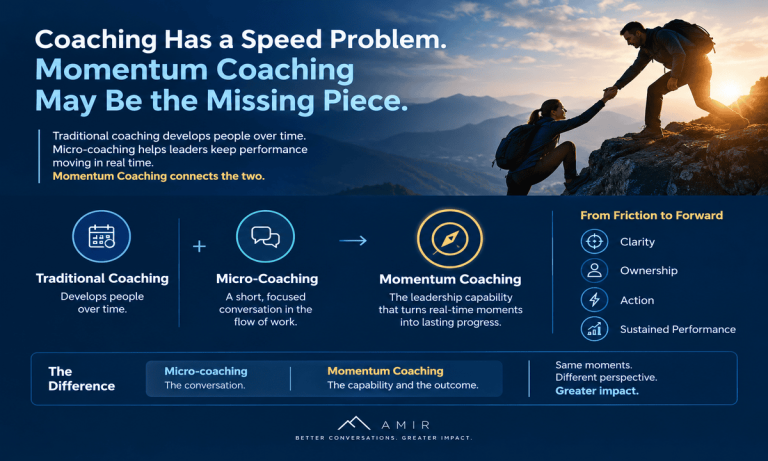
The sequence gives leaders a practical structure for brief, question-based conversations within the flow of work. Rather than taking responsibility for every problem, the leader helps the team member develop clarity, take ownership, and move towards action.
Effective micro coaching training therefore involves more than learning a collection of questions or behavioral signals. It helps leaders connect observation with a repeatable process for developing independent action.
Develop the Skill with Micro-Coaching Training for Leaders
Micro-Coaching Mastery for Leaders is a practical, self-paced course designed to help leaders apply the Micro-Coaching Core Framework™ in everyday workplace conversations.
It develops the skills needed to recognize potential obstacles, ask better questions, build ownership, and turn brief interactions into opportunities for progress—without turning every conversation into a formal coaching session.
Explore Our Micro Coaching training: Visit the course website
The starting point is simple: before trying to solve a problem, make sure you understand what is actually getting in the way.