
How to Help Employees See a Way Forward
Learn a practical micro coaching technique that helps managers guide overwhelmed employees toward a clearer perspective, better decisions, and a concrete next step—in just a few minutes.
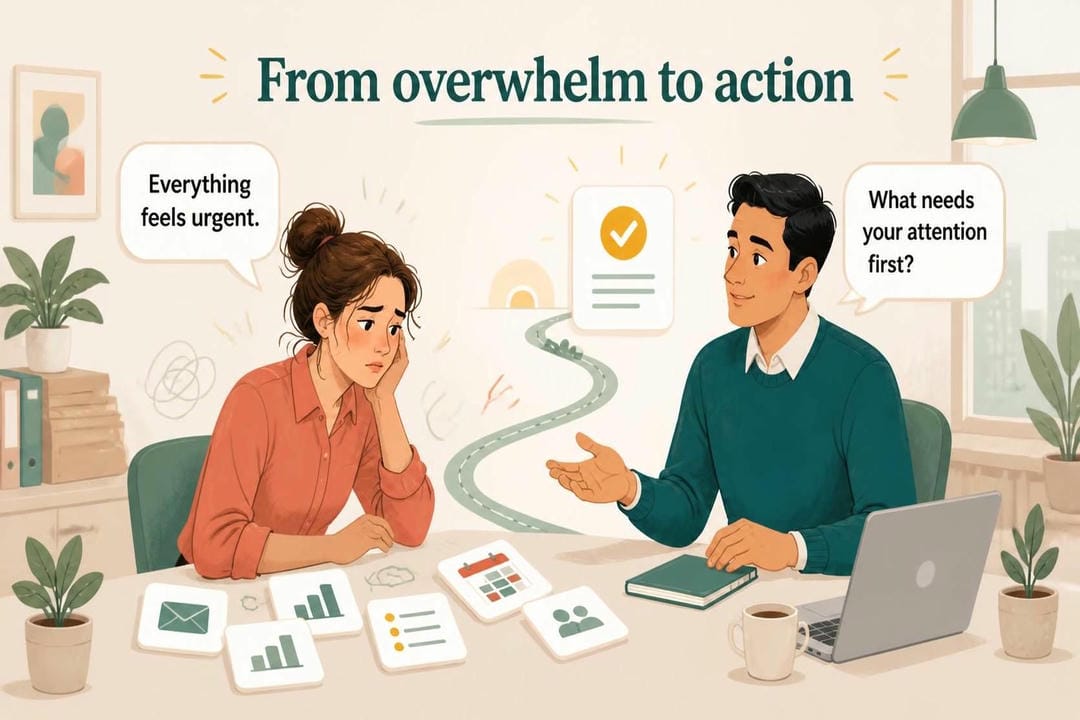
An employee walks into your office and says:
“I’m fed up. Everything is urgent, and I don’t know where to start.”
What do you do?
You could help them reorganize their tasks. You could tell them which deadline to tackle first. Or you could remind them that prioritization is part of their job.
Any of these responses might help. But there’s another possibility worth considering.
Perhaps the person doesn’t need another solution just yet. Perhaps they need help seeing the situation differently.
This is where Cognitive Fast-Shift can be useful. It’s a practical micro coaching technique designed to help someone step back from an overwhelming situation, see the bigger picture, and identify a useful next move.
You don’t need a formal coaching session, an elaborate set of questions, or a room full of flip charts. You need a few minutes, a genuine conversation, and an understanding of how to guide the person’s attention.
Let’s look at how to do it.
What Is the Cognitive Fast-Shift Micro Coaching Technique?
When people feel overwhelmed, their attention can become locked onto the most stressful part of a situation.
Three competing deadlines become everything is urgent.
A disagreement with a colleague becomes we can never work together.
A difficult project becomes there’s no way we’re going to finish.
The underlying problems may be entirely real. The deadlines may conflict, the relationship may need attention, and the project may genuinely be behind schedule.
But when someone sees only the pressure, it becomes harder to recognize distinctions, alternatives, and possible actions.
Cognitive Fast-Shift helps the person step back from their immediate interpretation and examine the situation from a more useful perspective. It isn’t about pretending everything is fine or persuading someone to be positive. It’s about helping them think more clearly about what’s happening and what they can do next.
The technique has three simple moves:
- Stop: Interrupt the automatic rush toward conclusions, reactions, or solutions.
- Zoom out: Look at the wider situation rather than focusing exclusively on the most stressful part.
- Focus: Identify a useful next step based on the broader view.
Think of it this way: when someone is too close to a problem, they may struggle to see the options around it. Sometimes the most helpful intervention isn’t to provide an answer. It’s to help them take a step back far enough to find one.
How to Use This Micro Coaching Technique in a Real Conversation
Let’s return to our overwhelmed employee.
Step 1: Stop — Don’t Rush to Fix It
Team member: “I’m fed up. Everything is urgent, and I don’t know where to start.”
A manager who wants to be helpful might immediately respond:
“Do the client report first. Then call Finance. You can finish the other task tomorrow.”
This may be a perfectly reasonable plan. But the manager has taken over the thinking before exploring the situation.
Instead, pause the rush toward a solution.
Leader: “Okay. Let’s take a step back for a moment.”
You might add:
“I can see you’ve got a lot coming at you. Let’s look at it together.”
That’s all you need at this stage. You’re acknowledging the pressure while inviting the employee to approach the situation differently.
The pause matters because it changes the direction of the conversation. Instead of immediately reacting to the feeling of urgency, you create space to examine what’s producing it.
You aren’t telling the employee to calm down. You’re helping them move from reacting to thinking.
Step 2: Zoom Out — Look at the Whole Picture
When people are overwhelmed, different demands can blur together. Every task feels equally urgent, every delay feels dangerous, and the situation can appear to have no workable solution.
Your next move is to broaden the view.
Leader: “What’s happening overall?”
Team member: “Three deadlines are coming up, and two people are waiting on me.”
Leader: “And when you look at those deadlines, is there anything that needs to happen before the others can move forward?”
Team member: “The design team needs the information I’m supposed to send them. They can’t finish their part without it.”
Now the employee has identified something important: one of the tasks is blocking another team’s progress.
The deadlines haven’t disappeared. The workload hasn’t magically become smaller. But the employee is no longer looking at three urgent demands as one undifferentiated mass.
This is the essence of zooming out. You help the person see relationships, priorities, and possibilities that were difficult to recognize while attention was fixed on the pressure.
Notice that the leader isn’t supplying an interpretation. The employee is discovering a more useful view of the situation through the conversation.
Step 3: Focus — Find the Next Useful Move
A broader perspective is helpful, but it isn’t the destination. The conversation needs to lead somewhere.
Leader: “Given that, which action would make the biggest difference right now?”
Team member: “I need to check two figures with Finance. I’ll contact them now and send the information to the design team by noon.”
Leader: “Is noon realistic, given what you still need from Finance?”
Team member: “Yes. I’ll message them now and explain that the design team is waiting.”
The employee now has a specific action, a deadline, and a reason for taking that action first.
The leader didn’t need to solve all three deadlines. The conversation helped the employee regain enough perspective to decide where to begin.
That’s a practical micro-coaching intervention: a brief exchange that helps someone move from feeling stuck toward clearer thinking and purposeful action.
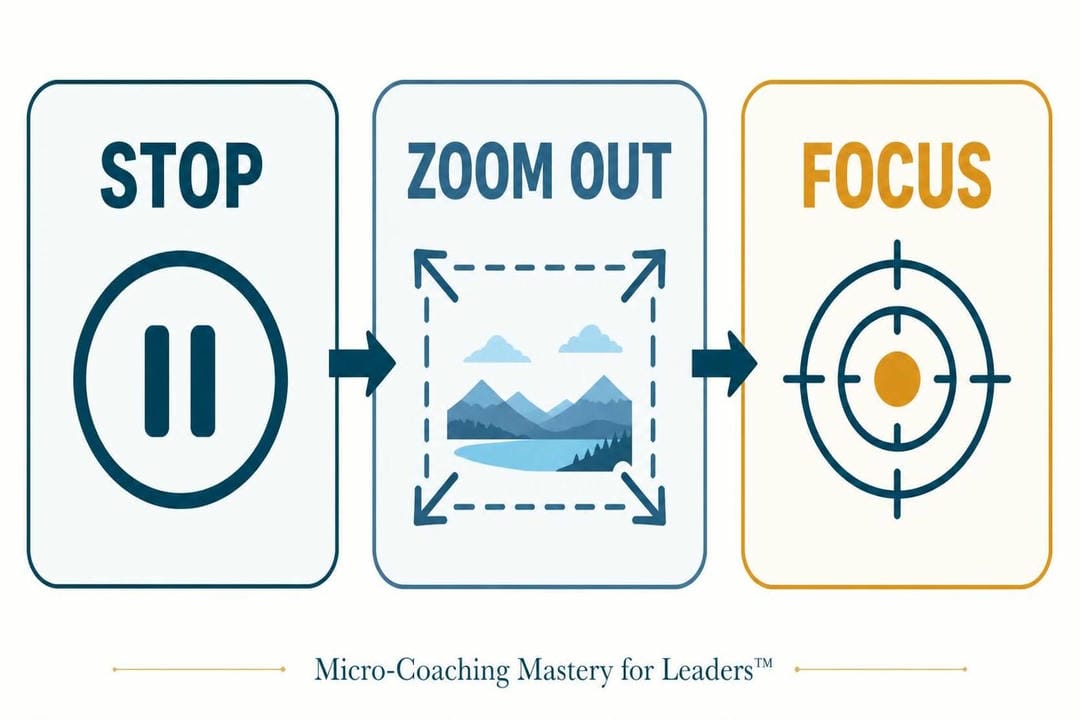
Table of contents
- How to Help Employees See a Way Forward
- What Is the Cognitive Fast-Shift Micro Coaching Technique?
- Why This Can Be More Useful Than Giving Advice
- Three Workplace Situations To Use This Micro Coaching technique
- A Seven-Day Practice Exercise for Managers
- One Technique Is a Start. Knowing When to Use It Is the Skill.
Why This Can Be More Useful Than Giving Advice
There’s nothing wrong with giving advice. Managers are responsible for making decisions, setting direction, removing obstacles, and ensuring work gets done.
The problem arises when advice becomes the automatic response to every difficulty.
Before applying this micro coaching technique, consider these two conversations.
Advice-first approach
Employee: “Everything is urgent. I don’t know where to start.”
Manager: “Finish the client report first. Then contact Finance and send the figures to Design by noon.”
The manager provides a plan. The employee may follow it, but the manager has done most of the thinking.
Cognitive Fast-Shift approach
Employee: “Everything is urgent. I don’t know where to start.”
Manager: “Let’s take a step back. What’s happening overall?”
Employee: “Three deadlines are coming up.”
Manager: “Which of them is holding up someone else’s work?”
Employee: “The information Design needs.”
Manager: “What can you do to move that forward?”
Employee: “I can contact Finance now.”
In the second conversation, the employee identifies the priority and chooses the next action.
The distinction is subtle but important. The manager isn’t merely solving today’s problem. They’re creating an opportunity for the employee to practise thinking through a similar problem in the future.
Of course, the second approach isn’t always the right choice. If an employee needs a clear instruction, lacks essential information, or faces an immediate safety risk, direct intervention may be necessary.
The skill is knowing when to give an answer and when to help someone find one with a micro coaching technique.
Three Workplace Situations To Use This Micro Coaching technique
The technique isn’t limited to workload pressure. It can also help when someone becomes stuck in a frustrating interpretation of a problem.
1. “Nothing Is Working”
A team member has tried several approaches to resolve a project issue and is losing confidence.
Team member: “We’ve tried everything. This project just isn’t moving.”
Leader: “Let’s step back for a moment. What have we tried so far, and what have we learned from those attempts?”
The employee might discover that although several approaches failed, one produced useful information about the cause of the delay.
Leader: “Given what we know now, what would be the most useful thing to test next?”
The situation hasn’t necessarily improved yet. But the employee can begin to distinguish between what hasn’t worked, what has been learned, and what might be worth trying next.
The shift is from nothing is working to we’ve learned something that can guide our next move.
2. “There’s No Way I’ll Finish on Time”
An employee is convinced a deadline is impossible.
Team member: “There’s no way I’m going to finish this on time.”
Leader: “Let’s take a step back. Look at the big picture, what remains to be done, and what could realistically be completed within the time available?”
The employee might identify a smaller deliverable, a task that can be delegated, or a dependency that needs immediate escalation.
Leader: “Given the time we have, what are our options? And what needs to be discussed with the project team?”
Sometimes the outcome will be a revised plan. Sometimes it will be a conversation about resources, scope, or deadlines.
That’s fine. Cognitive Fast-Shift isn’t supposed to make an impossible deadline possible through better thinking. It’s supposed to help the person see the actual situation clearly enough to decide what needs to happen.
Four Mistakes to Avoid
The technique is simple, but using it well requires judgment.
1. Don’t Use “Zoom Out” to Minimize the Problem
Telling someone “It’s not that bad” or “You need to see the bigger picture” can make them feel dismissed.
Acknowledge the difficulty before inviting a broader perspective.
Try: “I can see why this is frustrating. Let’s look at what’s happening and see what options we have.”
2. Don’t Force a Positive Interpretation
The goal isn’t to convince someone that a bad situation is good.
A project may genuinely be in trouble. A colleague may have behaved unprofessionally. A deadline may be unrealistic.
Help the person see the situation more fully, including the constraints and available options. Don’t replace one oversimplification with another.
3. Don’t Keep Asking Questions When Action Is Needed
Coaching isn’t an excuse to avoid your responsibilities as a manager.
If someone needs a decision, resources, a clear instruction, or intervention from senior management, provide it.
Sometimes the best next step is not another question. It’s removing an obstacle.
4. Don’t Mistake a New Perspective for a Completed Solution
An employee may leave the conversation feeling clearer but still lack the authority, resources, or time to act.
Once the person has identified a useful next step, check whether that step is realistic. If something outside their control is preventing progress, address it.
Cognitive Fast-Shift works best when the person can engage in a conversation but has become stuck in a narrow or overwhelming view of the situation. If emotions are escalating sharply, immediate safety is at risk, or the issue requires urgent intervention, address that need first.
A Seven-Day Practice Exercise for Managers
You don’t need to master the technique in one sitting. Start by noticing when people around you become stuck in an unproductive view of a situation.
Over the next seven days, look out for statements such as:
- “Everything is urgent.”
- “Nothing is working.”
- “We always have this problem.”
- “There’s no way we can finish.”
- “I don’t know what to do.”
When appropriate, try these three prompts:
Stop: “Let’s take a step back for a moment.”
Zoom out: “What’s happening when we look at the whole picture?”
Focus: “Given that, what’s the most useful next step?”
After the conversation, reflect on three questions:
- Did the person identify something they hadn’t considered before?
- Did their understanding of the situation become more specific or balanced?
- Did they identify a realistic next action—or did they need additional support from you?
You don’t need to use the technique every time someone complains. Nor should every conversation become a coaching session.
The purpose is to develop your judgment about when a brief intervention can help someone think more clearly and when the situation calls for a different response.
One Technique Is a Start. Knowing When to Use It Is the Skill.
Cognitive Fast-Shift is one way to help an employee regain perspective when they’re stuck. But leadership conversations don’t all have the same problem.
Sometimes a person needs help clarifying an assumption. Sometimes they need to take ownership of a commitment. Sometimes they already know what to do but keep postponing the action. And sometimes the manager needs to step in and make a decision.
Each situation may call for a different intervention.
The challenge isn’t simply collecting a list of coaching questions. It’s recognizing what’s happening in the conversation and choosing a useful response without making the interaction unnecessarily complicated.
That’s the thinking behind Micro-Coaching Mastery for Leaders™.
The course helps managers build a practical toolkit for everyday leadership conversations, with techniques they can use to support clearer thinking, stronger ownership, and better follow-through—without turning every interaction into a formal coaching session.
If this technique gave you a new way to approach an everyday managerial challenge, imagine having a broader set of practical interventions available when different situations arise.
Explore Micro-Coaching Mastery for Leaders™ to discover more ways to make short leadership conversations more effective.