
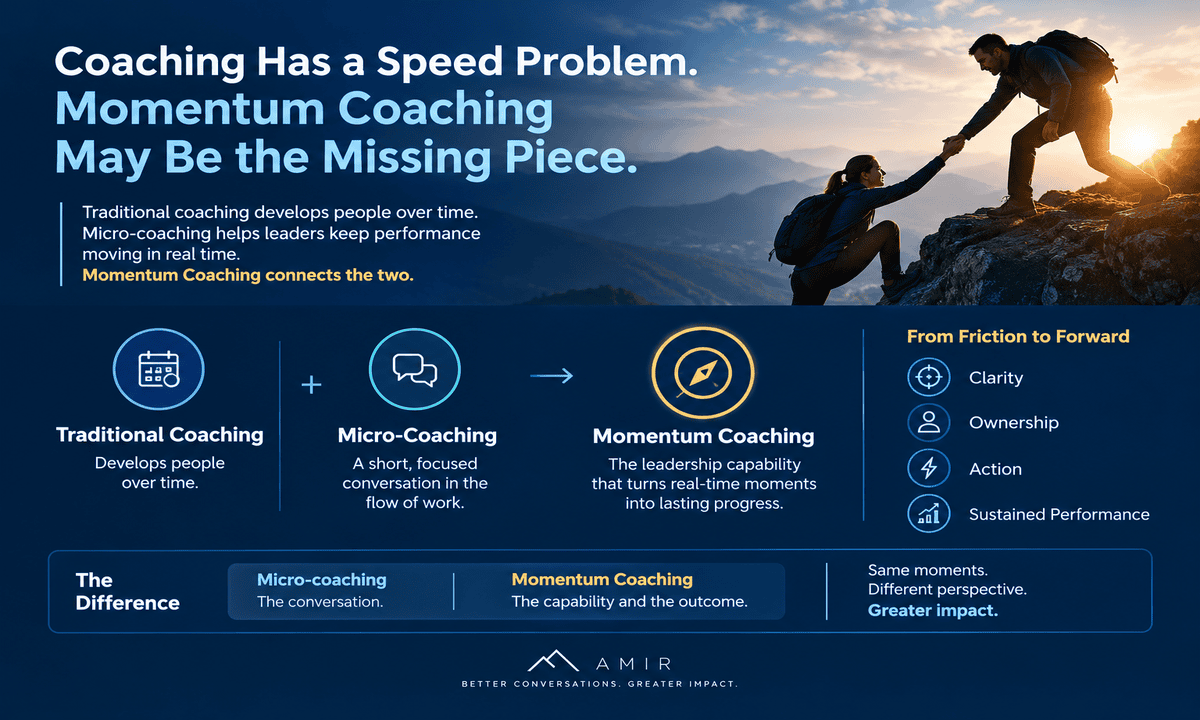
Conventional coaching develops people over time.
Micro-coaching helps leaders keep performance moving in real time.
Momentum Coaching connects the two.
That distinction may sound small. It isn’t.
Coaching has become an important part of leadership development. Organizations invest in coaching to develop leaders, improve self-awareness, build capability, and support behavioral change.
But there is a practical gap between developing people over time and helping people move forward today.
That gap is where micro-coaching can play a valuable role. It is also where Momentum Coaching becomes a larger leadership capability.
What Is Momentum Coaching?
Momentum Coaching is a lightweight leadership practice: short, focused coaching conversations inside the flow of work that help someone move from friction to clarity, ownership, and action—without waiting for a formal coaching session.
Micro-coaching is the conversation.
Momentum Coaching is the capability and the outcome.
The term micro-coaching describes the size and speed of the intervention. Momentum Coaching describes why it matters: it protects performance momentum.
The Problem With How We Think About Coaching
When most leaders hear the word coaching, they often picture a formal process.
A scheduled session.
A dedicated conversation.
A trained coach.
A structured coaching relationship.
Perhaps a certification, extensive practice, and a significant investment of time.
There is nothing wrong with that model. For many developmental objectives, it is exactly what is needed.
But it creates an unintended assumption:
Coaching is something you do when you have time to coach.
Work doesn’t operate that way.
Problems rarely wait for the next coaching session.
A team member misunderstands a priority at 10:15.
Someone becomes stuck on a task at 11:40.
A decision that should have taken ten minutes remains unresolved for two days.
A team member says, “I’m working on it,” but there is no clear commitment.
A leader notices that something is wrong but decides to deal with it in the next one-on-one.
And momentum starts to disappear.
Coaching Can Preserve Momentum
This is where we need to expand our definition of coaching.
Coaching is not only about long-term development. It can also be a way for leaders to preserve momentum in the flow of work.
That is the essence of Momentum Coaching.
Think about what happens when a team member gets stuck.
The leader has several options.
Give the answer.
Give instructions.
Take over the task.
Wait and see.
Schedule a meeting.
Or have a focused coaching conversation that helps the person regain clarity and move forward.
The last option does not replace conventional coaching. It serves a different purpose.
Micro-coaching is about addressing small moments of friction before they become larger performance problems. Momentum Coaching is about using those moments to keep work moving.
Why Momentum Coaching Matters
Performance is often slowed down by small things.
Not dramatic failures.
Not major organizational problems.
Small moments of:
- unclear expectations
- hesitation
- confusion
- weak commitment
- hidden blockers
- delayed decisions
- repeated misunderstandings
- unnecessary dependency on the leader
Each one may appear insignificant. But they accumulate. And when they accumulate across a team, they affect execution speed.
This is why micro-coaching is more than “short coaching.” It is a leadership tool for maintaining momentum—what I call Momentum Coaching.
Coaching in the Flow of Work
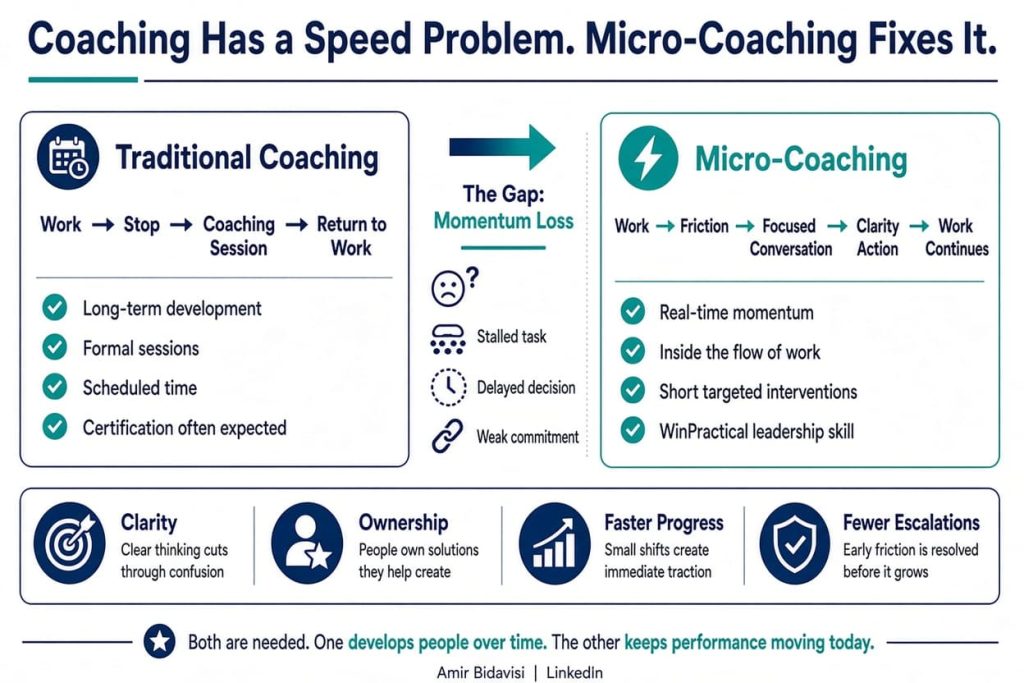
Conventional coaching can look like this:
Work → stop → coaching session → return to work
Micro-coaching can look more like this:
Work → friction → focused conversation → clarity → action → work continues
Momentum Coaching makes that second pattern intentional.
The goal is not to turn every workplace interaction into a coaching session. The goal is to recognize the moments when a short coaching conversation can prevent unnecessary loss of momentum.
The coaching happens inside the work, rather than requiring work to stop so coaching can happen.
This is micro-coaching in practice. It is also Momentum Coaching in action.
Does Coaching Require a Coaching Certification?
This is another assumption worth examining carefully.
Professional coaching is a serious discipline. Formal coach training and certification can be highly valuable for people whose primary role is professional coaching.
But leaders also need practical coaching capabilities.
A line manager does not necessarily need to become a professional coach in order to have a useful coaching conversation with a team member.
The relevant question is different:
Can the leader recognize an appropriate coaching moment and handle the conversation effectively?
That requires skill.
It requires listening.
It requires good questions.
It requires judgment.
It requires knowing when to coach and when to manage, mentor, instruct, or simply listen.
And it requires practice.
But it does not necessarily require turning every leader into a professional coach.
Momentum Coaching is not about certification. It is about capability.
The Real Challenge: Knowing When to Coach
Perhaps the biggest practical problem is not that leaders don’t believe in coaching. It is that they don’t always recognize when coaching is the right intervention.
A team member says: “I’m not sure what to do next.”
Is this a coaching moment?
Someone repeatedly misses a deadline.
Is this a coaching moment?
A capable employee suddenly becomes quiet in a meeting.
Is this a coaching moment?
Someone agrees with a decision but does not act on it.
Is this a coaching moment?
The answer isn’t always yes.
That is why practical micro-coaching needs to go beyond teaching a collection of questions. Leaders need to learn how to notice, understand, and respond to what is happening in the moment.
Momentum Coaching depends on that judgment. It is not about coaching every time. It is about coaching at the right time.
Momentum Coaching Is Not About Making Coaching Shorter
This distinction matters.
If we simply define micro-coaching as:
“Traditional coaching, but in 5–10 minutes.”
we have missed the point.
The duration is useful, but it is not the core idea. The deeper idea is timing and context.
Micro-coaching happens when a small intervention can make a meaningful difference to what happens next.
Momentum Coaching is the practice of spotting those moments and using them to restore momentum.
It can help a team member move from confusion to clarity.
From dependency to ownership.
From hesitation to action.
From a hidden blocker to an explicit problem.
From a conversation to a real commitment.
And from stalled progress back to momentum.
A Different Role for Leaders
This changes the role of the leader.
The leader is not expected to become a full-time coach. Instead, coaching becomes one of the tools available in everyday leadership.
Sometimes you need to tell.
Sometimes you need to teach.
Sometimes you need to mentor.
Sometimes you need to manage directly.
And sometimes the most effective intervention is to help the person think, clarify, decide, and take ownership for themselves.
That is where micro-coaching becomes useful. That is where Momentum Coaching becomes a practical leadership capability.
The Bigger Opportunity for Organizations
For HR and L&D professionals, this distinction also creates an interesting opportunity.
Organizations have invested heavily in leadership development and coaching programs. But learning does not automatically transfer into everyday behavior.
The question is:
What happens between the formal development experiences?
If leaders can use short coaching conversations during real work, coaching can become part of the everyday leadership system rather than something that exists only inside a development program.
That is Momentum Coaching at scale.
It can potentially support:
- greater clarity
- faster progress
- stronger ownership
- earlier identification of blockers
- better follow-through
- more productive conversations
- less unnecessary escalation
The objective isn’t to replace formal coaching. It is to bring useful coaching behavior closer to the moment when it can make a difference.
From Development to Momentum
Perhaps this is the shift we need to make.
Conventional coaching asks:
“How can we help this person develop over time?”
Micro-coaching also asks:
“What does this person need right now to keep moving?”
Momentum Coaching connects both questions.
Both matter. One focuses on development. The other focuses on momentum. And effective leadership may require both.
Coaching can develop people over time.
Micro-coaching can help leaders preserve momentum in real time.
Momentum Coaching makes that capability part of everyday leadership.
That is the opportunity: not another formal meeting, not a replacement for professional coaching, and not simply a shorter version of it. A practical leadership capability that brings coaching into the flow of work—where clarity, ownership, and action are needed.
FAQ: Momentum Coaching and Micro-Coaching
What is Momentum Coaching?
Momentum Coaching is a leadership practice that uses short, focused coaching conversations in the flow of work to help people move from friction to clarity, ownership, and action.
How is micro-coaching different from Momentum Coaching?
Micro-coaching is the short coaching conversation itself. Momentum Coaching is the broader capability and outcome: recognizing when micro-coaching can preserve performance momentum and using it effectively.
Does Momentum Coaching replace traditional coaching?
No. conventional coaching supports long-term development. Momentum Coaching supports real-time performance. They serve different purposes and can work together.
Do leaders need coaching certification to use micro-coaching?
Not necessarily. Leaders need practical coaching skills—listening, asking good questions, judgment, and knowing when to coach versus when to manage, mentor, or instruct.